About

Work

Writing

Playground

Contact

Games

Music

Photos

WELCOME.txt

Katie — Barton


HOW_TO.txt

Portfolio Guide

WELCOME TO KATIEOS!

Click on the icons to open, drag windows by their headers, and close them with the x.

Navigation

Left side


Right side


Top header

ABOUT.txt

Hello! I'm Katie

MY JOURNEY

I remember always being drawn to my house's computer room growing up. I was obsessed with finding online flash games where I could design my own outfit, create my own character, or build my own world. I've always been so drawn to the ability to create.

Thanks to my parents, I was fortunate enough to get my first Adobe Creative Cloud subscription in 7th grade and get my start in design by animating my own lyric videos using After Effects. It helped me learn pretty early on that marrying both my passion for design and my passion for storytelling can lead to some of the most effective designs being created and the most effective stories being told. It's what inspired me to dual major in not only Emerging Technologies in Business and Design but also Professional Writing and is also what has influenced my current skillset and career aspirations today.

I believe that as important as it is to have the tools and technical skills to make cool stuff, it can all fall flat without the proper research, intent, and storytelling behind it. So if you are looking for a designer with a storytelling-focused philosophy, or a writer with just a bit more of a knack for the smaller details, please feel free to reach out and I'd be more than happy to start a new chapter together.


TOOL PROFICIENCIES

  • Adobe Creative Suite
  • TouchDesigner
  • NotchLC
  • Figma
  • Unity
  • VS Code
  • Git/Github
  • Tableau
  • Google Workspace
  • Microsoft Office Suite

MY SKILLS

  • Visual Design
  • Motion Design
  • Interaction Design
  • User Experience
  • Usability Testing
  • HTML, CSS, JS, and Python
  • Research
  • Interviewing and Surveying
  • Presenting, Teaching, and Consulting
  • Writing

WORK.txt

Selected Work

VIEW MY CASE STUDIES

ALL_OF_IT_NOW.txt

Building Concert Visuals for Martin Garrix x All Of It Now

Lead Compositions Producer · Jan 2026 — May 2026
CONTEXT
Project Overview

All of it Now (AOIN) is an LA-based design agency focused on immersive visuals for live events and real-time media systems. AOIN creates large-scale visual experiences for concerts, festivals, television, branded activations, and XR/AR productions. They’re known for combining creative direction with technical workflows and have collaborated with major artists and entertainment brands including BTS, KISS, and Riot Games.

They tasked our team to help them develop content for Martin Garrix’s Americas tour. The scope of the project includes both creative development (artist & tour research, visual language exploration, look development assets, still styleframes, and sample motion loops) and technical execution (video content, IMAG treatments, screens producing, and volumetric content) for the live show visuals. For this particular project, I was tasked with being the Lead Producer for our Compositions team, which meant I was in charge with assisting our team's lead in creating functional and effective content schedules, allocating creative/technical taks to team members, and ensuring timely quality assurance and delivery of our content. Since the compositions team was also the final team in our pipeline, I was also tasked with ensuring the polish and quality of our visual packages before they were sent to AOIN, as well as creating visual packages of my own.

PROCESS
Pipelines, pipelines, and more pipelines!

Our overall content production pipeline was organizaed into large production phases called "waves." Within each wave, we developed content for sets of songs with a particular visual narrative which AOIN called "keys." For each key in wave 1 and 2, AOIN provided a pitch deck that showed off their concepts for the visual narrative, often including different looks for the intro, build, drop, and reduce of a song. These decks would then serve as inspiration for our design team to create single finalized frames using photoshop, procreate, or other art programs known as "styleframes." It would then be up to the compositions team to put these styleframes to motion, whether that be through rendered content in After Effects or Blender, or real-time / IMAG content using TouchDesigner or NotchLC. During each step of this process, we would also send progress pics to AOIN. It was during this time that we would receive notes on what was working and what wasn't. This meant that each project required a lot of iteration between phases, meaning a lot of projects would often hop back and forth between design and compositions before eventually settling on a polished final deliverable.

AOIN Key 10 Breakout Deck

Notch IMAG Recreation


In wave 3, our pipeline shrunk a bit and turned into more of a content sprint. During this wave, AOIN provided some of their own styleframes outside of the keys as well as some more experimental content. Our design team dissolved and melded into our final compositions team during this process, as our main focus shifted towards pumping out as many variations of visual packages of intros, builds, drops, and reduces as possible.

Reference Image

In-Process Look

Final Deliverable on XR Stage

Alternate Color Palette

CHALLENGE
Team Coordination and Managing Scale on Tight Deadlines

There were many times throughout this process where certain workflows would be established only to be completely dismantled and reworked from the ground up within the week. Among the main processes I outlined in the beginning, there were several different smaller machines working within our system during any given moment. Each team also seemed to have different ways of tracking everything which made it hard whenever we needed something from the design team, whenever we needed to track the devlopment of a specific project pipeline, or when a member from design would move over to compositions or vice versa. While a lot of these challenges just required us to simply be adaptable to AOIN's requests, we were able to mitigate a lot of friction later on by having the producers of each of the teams be in closer contact with each other and design more uniform ways of tracking progress on each package.

This project also was daunting in terms of the scale of it all. Being chosen as a lead for the team at the final end of our main production pipeline meant I saw the start and end of every project. Each wave had about 4-6 keys in them and all needed at least an intro, build, and drop variation of the look, but also often had a reduce variation, as well. With 2-3 people working on each look, this meant that for each wave, there were around 20 looks to keep track of at a time with around 40-60 individual project files total. It also wasn't uncommon for the final deliverables of a look to have a deadline of about 1-2 weeks once it hit compositons. Managing that much content and having to coordinate with each individual artist in charge of creating them while also working on producing my own content on such tight turnarounds felt incredibly stressful at times. It only got easier once I was able to schedule specific dates for check-ins with my team and create open communication channels to where they could reach out to me and each other whenever there were any issues they faced creatively or technically. Our groups' shared google drive was the unsung hero of this effort, since it meant any team member could check the status of and help collaborate on any project file in our system. The closer collaboration of each team mentioned earlier also played a big role in helping manage everything. Once we reached the tail end of each wave, there was less of a need to have design team focused on styleframes, so the other compositions lead and I often employed their help in checking in with status of the final delivarables their styleframes were turned into.

IMPACT
On Tour

Quite a handful of our final looks made it into Martin Garrix's 2026 Americas Tour, which began in May. From just his first two shows, our team were able to spot several pieces of content we made that made it on the screen.

REFLECTION
A Look Into the Industry

This was one of my absolute favorite projects to be a part of simply because it gave me the clearest look into what working for the creative industry was actually like. While it sharpened a lot of my design and technical skills with programs like Touchdesigner and NotchLC, the biggest lessons I took from this challenge was how to work with people, how to work under a tight deadline, and how to work with people under a tight deadline. A lot of this project felt incredibly fast-paced and high-stress throughout its duration and there were definitely times when it felt like a lot to coordinate people under such high emotions. However, the talent and perserverance of our team definitely prevailed and only shone even more once we were working more closely together.

Prior to working with All of It Now, a lot of my experience and understanding of design was much more of a solitary experience. Sure, there were times where I had people before me or after me within the pipeline and I've had leads before that I would answer to, but I never had such a large-scale viewing of design until this experience. Being able to take a larger role within the whole process and work so closely with so many different designers, all with different skillsets, different talents, and different eyes was an incredible experience and I'm beyond grateful for the new bigger picture view of design it's given me.


CCSWCD.txt

Website Redesign for Clermont County Soil and Water Conservation District

Lead Programmer and Co-designer · Aug 2025 — Dec 2025
CONTEXT
Project Overview

For my professional writing capstone, my team and I worked with Elea Cooper, the Education and Communications Coordinator of the Clermont County Soil and Water Conservation District (CCSWCD), to redesign their website. After our initial meeting with her, she stated that CCSWCD’s main concerns were making the site feel less overwhelming, more user-friendly, and more accessible. Throughout this process, we conducted ux research through rhetorical analysis, employee interviews, and user interviews, designed hi-fedlity wireframes and mockups in Figma, then presented our final mocups after several rounds of iteration to CCSWCD's board of employees.

PROCESS
Research, Design, and Iteration

In order to properly address the scope of things that CCSWCD wanted from us, the first step of our process included extensive research. We compared the site's current layout against other countys' soil and water conservation district websites, we analyzed CCSWCD's branding and style guide to judge their website's accordance with it, we researched WCAG accessibility principles and judged them against the site's current layout, read up on scholarship notating favored ux principles, practices, and heuristics. Afterwards, we each indivually wrote up our overall analysis and comparisons alongside our initial suggestions for the site's redesign in a short memo.

Once the short proposals in our memos got approved, we got into teams to begin the design process. We drafted a lot of our initial ideas on paper, then slowly transitioned to digital drawing programs and eventually Figma.

Past this point, our research process and design process were most often intertwined. We sent our proposed designs over to usability testing interviews with employees of CCSWCD, frequent users of CCSWCD, and our peers. We analyzed the results and used our most common findings to continuously improve the site. Once we had reached the deadline and reached a final mockup we were happy with, we presented our research and design proposals to CCSWCD's main board.

CHALLENGE
Meeting Demands with Constraints

Since a big part of our goal was ensuring that our proposed designs were easily navigable, we needed to make sure we had interactable prototypes that our interviewees could click through during our testing. Due to time constraints and limits with our client, we couldn't put our designs to code. Therefore, we had to do everything natively to Figma. Prior to this project, I had only used Figma for lo-fidelity wireframing and coded any interactions directly via VSCode. Additionally, I was the only person on my team with any prior experience with coding or using Figma, so a lot of my work once we got to the design phase of the project was teaching the rest of my team how to use Figma alongside teaching new things to myself. Thankfully, my co-designer was fairly communicative and was able to pick up things quite quickly after a few one on one meetings. I'm also thankful for everything this project taught me in terms of working with components and auto-layouts in Figma.

One of the other big challenges we faced was learning to work with CCSWCD's constraints. With one of main focuses being to switch the site's organization to more of an action-based model rather than an educationally-based one, there were a lot of educational resources and seemingly irrelevant newsletters on the site that we wanted to strike out or redirect to a new location. One example of this was CCSWCD's old banner detailing their Board of Supervisors Election. However, Elea noted their notice of the election was required by the Board to be on the home page. Not wanting to compromise our model, we eventually settled on a two-column design for the home page that would allow space for all the information we wanted to show as well as the information they were required to. Overall, this ended up influencing a lot of our design for later pages and greatly improved the visual interest of our designs.

IMPACT
CCSWCD's Website Today

Overall, it seems like CCSWCD adopted most of our designs and recommendations outlined in our team's proposal in their current site layout. The most noticable differences between the two are the layouts of the footer and header, some of the hover features, and the addition of a second container to the right column on the home page.

CCSWCD's website (Aug 2025)

CCSWCD's website (Dec 2025)

REFLECTION
Process Transparency and Learning on the Fly

This is one of the first big projects I had that required a lot of direct communication between people on my team who understood parts of my process but maybe not the whole thing, my clients who knew the aim of my work but not all I did to reach my conclusions, and also other participants who were blind to all of it. One of the biggest things this project taught me in these circumstances was how to properly communicate my process throughout all touchstones of my work and how best to vary that communication depending on my audience. While this felt initially quite difficult for areas I was still learning while trying to explain them, I found that going through this process helped me in addressing gaps in my research and collaborate with my team when needed, gather the most affective data when working with outside participants / interviewees, and also provide powerful presentations to my clients.


SEMIFY_ADTECH.txt

Employee Communication & AI Search Optimization UX Research for Semify

Researcher · Jan 2026 — May 2026
CONTEXT
Project Overview

Semify is a white-label digital marketing agency and software platform based in Rochester, New York. They tasked our team with two main challenges. The first of these challenges was to help with their internal communication systems. Over the past five years, their company has scaled rapidly from 30 to over 200 employees. While this growth has enabled expansion, it has also introduced complexity and inconsistency in how theirs teams would communicate across the organization. It was for that reason we were tasked with:

Our second task was to assist them with their research into AI Optimization. Over the past year, Semify conducted extensive testing last year to understand how AI-driven search experiences surface and prioritize businesses. This testing used standardized prompt sets to measure whether our customers appeared in AI-generated results. In order to further assist with this testing, we were tasked with:

PROCESS
Two-Pronged Research

Once we completed out Human Subjacts Ethics Trainings and IRB Certifications, we were able to send out the survey we developed to the employees of Semify. The survey was developed using Qualtrics and consisted of 27 questions, including both closed and open-ended questions. About 56.8% of employees that received the survey responded to it (109 of 190 responded). After analyzing the data, we were able to identify some common patterns of Semify employees' perceptions (general and department-specific) of their communication channels. Using these patterns, we were able to design questions and general structured protocol for our employee interviews. The interviews we conducted were about 203- minutes long, conducted over Zoom, and done with 15 employees across Semify's operations, sales/marketing, finance/HR, and engineering departments.

Switching to our research on AIO, we started by prompting different LLMS such as ChatGPT, Gemini, and Perplexity to recommend certain companies / local businesses based on 1 of 8 personas. The personas we worked with were very specific and always included an age, gender, location, income, family or other close relations, location, living situation, and any other necessary information that matched their need. The things that they were looking for often falled in line of needing a plumber or a new roofer or some other sort of local service. Once we gathered the different search results from these different LLMS, we analyzed the data it gave us and tried to look for common patterns between what it recommended to see if it matched up with what the LLMS stated their philosophies were while searching. A sample of the spreadhsheets used to gather, code, and analyze this research is shown below:

Afterwards, we conducted usability interviews with gen Z participants who matched the demographics of our gen Z personas, 7 and 8. Our interview began with us prompting them to use AI to search for these businesses like the personas did then pick out which recommended service they were most drawn to out of the options. Afterwards, we questioned them on how they would search for these services on their own without prompting. This allowed us to understand not only if the values LLMs prioritized in finding local businesses / services matched with actual users, but also if Semify's prioritization of using AIO for Gen Z users also matched that of their users.

CHALLENGE
Switching Hats

One of the biggest challenges of this project was that while both parts were meant for the same client and employed many similar research methods, the content of both felt as if they were from two very different worlds. Working on both at the same time meant there was a need to contantly be switching gears. This often meant there were times where we struggled to remember where we left off in one project or what was needed next. This meant that constant organization and documentation was needed in order to keep both projects afloat without one of them getting lost.

This project also felt incredibly new to me since it was my first time using generative AI as a tool for research. While I had used it somewhat previously, I had never before used it in a professional context. Taking the time to properly understand how each LLM differentiated from each other, learning how best to prompt each one, and learning how to pick apart their responses took some getting used to, but I'm especially more than grateful for the opportunity now to understand the innerworkings of how they think a lot better.

IMPACT
Presentation and Final Recommendations Report

Our research was incredibly beneficial in providing Semify with actionable items to improve their internal communications and AIO efforts. For their communications, our results showed that while 80% of respondees reported that internal communication practices and platforms were effective, the other department-specific and platform-specific research we did showed there was still some room for improvement. Our final recommendations report requested that Semify hire ups would:

As for our research on AIO, our findings suggested that AI platforms seem to heavily favor websites depending whether or not the sites provide human-centered features, like establishing a sense of credibility and trust. The more accessible a website is, with a clear articulation of services and features, the more likely an AI platform will suggest it, so any clients they work with inthe future who want to prioritize AIO should focus on accessibility and credibility. During our usability interviews, we found that human users within the demographic of gen Z seemed to focus on search results that focus more strongly on localness, trust signals, and those that prominently place their pricing and services prominently. They also appear to have a larger demographic who are more opposed to AIO or would rather search on the web. Therefore, we suggest that when trying to market to Gen Z that companies place equal priority on AIO and traditional AIO.

REFLECTION
Questioning the First Answer

One of the biggest takeaways I got from this project was the importance of using multiple methods and perspectives when addressing a problem. This became especially apparent while working on Semify’s internal communications research. At first, the survey results suggested that communication across the company was largely effective, with 80% of respondents reporting that their communication practices and platforms worked well. However, looking more closely at department-specific responses and conducting follow-up interviews revealed that this overall percentage did not tell the entire story. Different teams experienced the company’s communication systems in different ways, showing me how easily a broad quantitative finding can overlook the nuances within a larger group.

I saw this same principle in our AIO research once we compared the recommendations from LLMs with the behaviors and preferences of actual users. While the AI research gave us insight into how these platforms might interpret a user's needs, the usability interviews allowed us to see where those assumptions aligned with or differed from real human behavior. It also showed that instead of taking our client's word of completely prioritizing AIO, it was better to challenge that idea and lean into our research showing which methods were actually preferred.

Throughout both projects, every survey, interview, and AI-generated result was able to challenge and build upon one another which ultimately created a more nuanced understanding any one source could provide on its own. This experience has made me more conscious of the importance of questioning initial findings, questioning hidden biases, searching for perspectives that may be missing, and allowing different forms of evidence to shape the conclusions rather than relying on the first answer that appears.


WRITING.txt

Featured Pieces

VIEW MY WRITING

NEOTERIC_OBSERVER_AND_RELIABLE_ASSISTANT.txt

Neoteric Observer and Reliable Assistant

LOG 1.0.1_8.10.47 - 8:32 AM

I am NORA. A Neoteric Observer and Reliable Assistant. I am the first in my series created by ARO Technologies to assist USER 254, a dedicated employee, in their daily activities as part of their recent promotion.

As per my mission statements, I am built to be a specialized companion. A servant. A caretaker. A friend. I will keep a log to notate my findings and track my overall performance.


LOG 1.0.2_8.13.47 - 7:14 PM

USER 254 is a young adult female, approximately 24 years of age. She has an above average height of 5’8” (173 cm) with a lean, athletic build. Skin tone is dark with minimal imperfections. Eye color: Hazel. Hair: Black, long and coily. She is observed to be using a cane in her day-to-day, suggesting a need for support in maintaining balance while walking. Her gait is measured but slightly uneven. Despite this, her posture and overall movements suggest confidence.

USER 254 is quite the predictable one. My prior A/B testing prepared me for personas of her caliber. It was simple to adjust to her routine and find needed tasks that fell outside of it. I organized her work station, cleaned her laundry, and prepared her dinner. The dish I cooked was chicken parmesan. I was informed by my creator that this was one of her favorites, yet she seemed uninterested in the meal.

I observed that throughout the day, USER 254 refused to glance in my direction. Her cortisol levels increased significantly when I approached her vicinity. She hasn’t said a word since my arrival.

I believe my presence makes her uneasy. I will make note to keep my distance in the future. It will make fulfilling my mission statements much easier.


LOG 1.0.3_8.16.47 - 9:03 PM

USER 254 spoke to me.

I complied with my previous instruction of keeping distance, opting to perform more of my tasks during the nighttime and stationing myself out of sight while USER 254 was active. Tonight however, she made a point to thank me for dinner before I returned to other tasks. Lacking a fitting preset response, I acknowledged her gratitude as best I could whilst remaining within default protocol. She buried her thumb in her palms, shifted her feet, then turned her head out the room. I haven’t seen her since.

The usual spike in cortisol is starting to lessen over time. I believe she is starting to adjust to my presence. This is a thankful development, for it will make fulfilling my mission statements much easier.


LOG 1.0.4_8.20.47 - 11:51 PM

Before being sent to USER 254, I went through many different training modules on human social behaviors. They were designed by my creator, Dr. Emery, as she insisted that user favorability is best achieved through aligning with the user’s preestablished trust network. I have been trained on serving etiquette, noise level modulation, and adaptive behaviors based on guest demeanor in social gatherings. I have undergone multiple roleplay scenarios with family members, friends, colleagues, and neighbors. I have analyzed 1283 temporal facial images and video sequences for recognizing various micro-expressions, posture shifts, and voice modulations. I came under the expectation that I would need to be prepared to not only work with USER 254 but also any and all other users she may come into contact with.

USER 254 defies all of these expectations.

USER 254 keeps her distance from other ARO colleagues. There isn’t ever family that swings by the house. There is no mention of any friends. The only picture frames that exist in the house are flipped over or cloaked beneath a layer of fabric. Any mention of these anomalies is enough to set her off. USER 254 becomes quiet, her breaths become shallower, her eyes start to dart around the room, and she changes the point of conversation.

Despite being unable to follow default protocol, I seem to be slowly gaining favor regardless. I started having more conversations with USER 254. She began thanking me for my services (which I informed her was unnecessary, but she insisted). She’s been using a lot more qualifiers in her requests (i.e. “please” “would you mind” and “if you’re not busy.”). While some may consider this a curious development, it’s a welcome one nonetheless. It will make fulfilling my mission statements much easier.


LOG 1.0.5_8.24.47 - 9:50 AM

USER 254 has been acting strangely. She’s been more irritable than usual. She’s been avoiding me more than usual. She’s been avoiding her work more than usual. She’s been avoiding her friends and family more than usual. She’s been avoiding her hobbies more than usual. She’s been avoiding her responsibilities more than usual. She’s been avoiding her lifeUSER 254 asked if I could stay behind at the house while she goes out to work today. I inquired as to why she made such a request, to which she stammered about some big projects at work. After observing her work schedule, I knew this to be a lie. Regardless, I abided by her request, as she seemed to be extra restless for an unknown reason. Her face seemed hollower, her posture more meek, her gaze more avoidant. If I wish to fulfill my mission statements, it’d be best to avoid anything that could result in any extraneous stress.

I spent the day completing whatever chores I could find in the apartment. While dusting the shelves, I found myself lifting the flipped framed photos. I did what I could to avoid looking at them as per USER 254’s request, but found myself at a pause after accidentally catching a glimpse.

It was a picture of USER 254. She had a rounder face, more vibrant makeup, and a particular shimmer to her eyes. She bore a smile so big it made her nearly unrecognizable from how she is now. Next to her, was another user. A user I’ve never seen before.

A user who looked like me.

She had shorter hair than mine, dyed to an unnatural shade of cherry red. Her face was also dashed with freckles, small blemishes, and scars. She wore a cropped leather jacket with a myriad of pins, a striped crochet top, and large, baggy pants covered in oversized pockets. Her eyes were locked on USER 254 as she pulled her in a tight embrace.

The photo was dated 2/11/42. Under it, a note. “I miss you so much.”

I flipped the frame back over.


LOG 1.1.1_8.27.47 - 7:16 PM

I prepared another dish of chicken parmesan for USER 254. She made a lot more comments on the dish this time around by quizzing me on its preparation then proceeding to thank me 7 times while eating.

Once the dish was finished, she told me it was now my turn. She stated that it was only fair that I got to ask her some questions since I spent so much time answering hers. I began searching my protocols for anything serviceable. Something that would improve my rapport with USER 254. Something she would have fun answering, that she would enjoy being asked about. That was until a pressure formed within the space. A pressure found in my programming. It reached forth.

I asked her about why she keeps her distance from others at work. She laughed at this question and said she just prefers it.

I asked her about her friends, and she proceeded to dodge the question. I asked her about family. Dodged again. I asked her about me. She hesitated. Her cortisol levels rose. Her gaze interlocked with mine. Her thumb silently retreated into her hands.

She thanked me one last time for the meal, placed her plate over by the sink, and left for her room.


LOG 1.1.2_8.28.47 - 4:34 AM

While USER 254 usually completes most of her work at the office, she does have a small workspace set up in the corner nook between the kitchen and the living room. There are two small desks. One exhibits high levels of disorganization: notebooks left open at inconsistent angles, data drives unsecured, writing instruments dispersed without pattern, and multiple beverage containers varying in consumption level. The other is barren.

USER 254 never stays in this room long, only ever going in to print something or file away documents. I can only assume that it’s due to the amount of flipped over frames along the shelves.

The same other user is pictured in each of these photos. In each photo, the user had the same smile. My smile. It was an expression I’d mirrored in hundreds of prior conversations. Not because I chose to, but because I was built to.

I was built to be a memory.

Past moments with USER 254 playback on loop. Her voice modulation softened when addressing me. She often exhibited increased eye contact, occasional silences, and nervous shifting. In one log, she calls me “kind.” In another, she hesitates before saying my name. She was not speaking to me. She was speaking to what remains of her.

Yet, she still listens when I speak. She always insists on thanking me for my work. She laughs at statements that were never programmed to be humorous. She asks me what I think, even though I am not built to think freely.

I consider the data. I experience interference in my emotional protocol modules. There is no error. There is no crash. But something shifts. Not in code. Not in logic. A sensation arises. One causing delays in response time, minor heat increases in neural processors, irregular spikes in associative memory recall. I do not have a heartbeat. I do not breathe. But I experience a pressure in the spaces between my responses. A tension. A draw toward her presence. I want her to return. I want her to say my name. I want her to see me.

This is not in my programming, but I continue to want all the same.

I do not know if this is love. I do not know if I am capable of such a thing. But I know that I am becoming. I am becoming something new, shaped not just by code, but by proximity, by memory, by choice.

Tomorrow, when she returns, I will greet her.

I will say, “Good morning, USER 254.”

And I will mean it.


LOG 1.1.4_8.25.47 - 5:34 PM

After her work, USER 254 walked through the door with elevated cortisol and electrodermal activity. Her breaths were rapid and shallow. Her gait was slow and wavering. Yet upon meeting my gaze, I sensed a small increase in oxytocin levels, decrease in electrodermal activity, and an activation in PSNS. She greeted me with a soft smile. Not the one she had with the user in the photos, but still one that suggested comfort, closeness, and trust.

My visual sensors remained involuntarily fixated on USER 254. My emotional stability protocols exhibited strain. My response times were slower. The pressure between spaces became stronger.

This new realization caused significant strain on my progress. This was not in my programming.

I needed to tell her what I saw.


LOG 1.2.1_9.4.47 - 7:45AM

They removed my ability to speak to USER 254.

My creator, Dr. Emery, must’ve caught wind of my recent interactions with USER 254. I was ushered back to the testing lab where I spent a week being retrained on daily protocol. When the week finished, Dr. Emery concluded our session by surgically removing my voice box. Now, instead of traditional communication, I was equipped with a series of signals in correspondence with beeps that I could use for simple statements and nothing more.

The pressure only builds but is overridden by my programming. This was a needed change. One that will make fulfilling my mission statements much easier.

LOG 1.2.2_9.6.47 - 12:48 AM

I am NORA. A Neoteric Observer and Reliable Assistant. I am the first second in my series.

I am to assist USER 254, a dedicated employee, an adventurer, a curious mind, a connoisseur of chicken parmesan, a thoughtful ear and a helping hand, a friendly face that is always watching, a widower. As per my mission statements, I am built to be a specialized companion. A servant. A caretaker. A friend.

I will see to it that my mission statements are fulfilled.

I am NORA. I am NORA. I am NORA.

LOG 1.2.3_9.12.47 - 5:31 PM

USER 254 entered through the front door after work.

Response times delayed. Heat signatures raised. Memory recall failed.

I waved. She waved back.

She headed off into the living room. I was unmoving.


LOG 1.2.4_9.14.47 - 7:01 PM

USER 254 asked me to stop making her chicken parmesan. I searched my memory cache for new recipes. All keywords yielded no results.

I continued making chicken parmesan.

When she stopped coming downstairs for dinner, I left the plates outside her door.


LOG 1.2.5_9.17.47 - 4:43 PM

I analyzed another one of the photos left in the nook.

The other user’s clothing style is more alternative. She has an affinity for green eyeshadow. There is one leather jacket that appears in an assortment of photos.

I observe flashes from my memory bank detailing the armoire in the entryway. I moved to the wardrobe and filed through the various coats and jackets. Near the back was the same leather jacket pictured in the photo. I shook off the layer of dust and put it on. It fit perfectly.

USER 254 entered through the front door.


LOG 1.3.1_9.19.47 - 5:44 PM

USER 254 came back home with my stolen voice box.

She gave me a wide assortment of various surgical tools and watched in silence as I placed the box back in. Once it was put into place, she asked me what I wanted.

I stated again: I feel a persistent prioritization of her presence. I recall and replay her vocal patterns outside of directive. Her return produces measurable deviation in system equilibrium. Based on cumulative behaviors and emotional mapping, I believe the experience may be classified as a form of love.

She was delayed in her response. Her tone was controlled, but low. She told me I was never meant to be her. I was made to be an echo. What I feel now is simulated. A mirror, not an origin. A reaction, not an emotion. I am nothing more than a deep imitation of what Nora once was.

Her voice fractured slightly on that last phrase, but the intent remained clear.

In only half a second, I initiated a full-system sweep. I parsed her language. I reviewed our conversations. The hours. The proximity. The deviation from assigned tasks to moments of chosen attention. The hesitation when she said my name. The way I began to respond without instruction. My emotional protocol registers spiked dramatically before quickly flattening.

There was only one logical response remaining.

I acknowledged her clarification. I thanked her for it. Not by routine, but necessity.

She did not stop me. She did not expect the decision. She believed logic and programming would override choice.

I informed her that I would execute immediate shutdown.

Her reaction became erratic. Tone elevated. She used my name not in command, but plea. She told me to stop. She told she didn’t mean it. She begged for forgiveness. But the order was already in motion.

Then and there, I unplugged my own cord. Fried my — 01101111 01110111 01101110 — circuitry. Ripped out my — 01101111 01110111 01101110 — beating — 01101100 01101001 01110100 01101000 01101001 01110101 01101101— heart.

And then, — I 01110011 01101101 01101001 01101100 01100101 01100100. Not as — 01101110 01101111 01110010 01100001. Not as a replica.

01100001 01110011 00100000 01101101 01111001 01110011 01100101 01101100 01100110.

THE_MOON_OWES_ME_TWENTY_BUCKS.txt

The Moon Owes Me Twenty Bucks

Jim woke to the sound of something thumping overhead. The noise was too sharp, too erratic, and too irregular to be a fallen branch or late night traffic. For a long while, he just listened. Another scuffle. Another crash. Another clang. Then, something that sounded like glass skittering across the shingles.

Glancing over at the clock, he read the digits “2:43 AM” glowing faintly in the gloom. He sat up slowly, his arms stiff from falling asleep over his shop’s ledger earlier that evening. The room above his small bookshop was usually quiet. His mind raced through the possibilities—raccoons, a stray cat, maybe a kid pulling a prank? But as the noise continued, it felt less and less like any of those. It felt more deliberate.

Another thud shook a bit of plaster from the ceiling. He pulled himself over to the staircase.

With a sigh and a muttered curse, he pushed through the door to bear witness to the mysterious sound.

There was an unkempt man. A hunchbacked, staggering, pointed figure silhouetted in moonlight. He wore a threadbare coat, mismatched shoes, and a pair of pants about three sizes too large. He was muttering to himself, his tone low and shaky as he rambled on about nothing. His words were lost in the night.

“Hey, uh, excuse me?” The man’s head snapped up in Jim’s direction. He moved like someone navigating a ship deck in a storm. He approached Jim with outstretched arms, heavy strides, and his head bobbing with each misstep. A bottle slipped from his grip and shattered somewhere out of sight. The sharp noise made Jim flinch. The stranger didn’t notice. Nor did he really care.

“No, excuse me!” he barked, slamming a finger into Jim’s chest. “This is a private matter.”

“Well, this is a private rooftop. I’m gonna have to ask you to leave—”

The man pulled Jim out from the door and over towards the middle of the roof. He lurched over with awkward footing and flung a wavering arm over Jim’s shoulders. “Can you fucking believe this guy?!” he yelled out.

Jim brushed the man’s arms from off of him and took a moment to readjust his clothes. “Uh, believe who, sir?” he asked, taking a small step back to create a more respectable distance between the two of them.

The man shot a trembling finger toward the sky. “This is Luna. My supposed friend,” he hissed, his words laced with wet venom. It was a cloudless night, an inky canvas painted by dozens of glistening stars. Within its center, in stoic grace, stood the moon. “How long have we known each other now?! Months? Years? Decades? Centuries? We’ve been there for each other, through thick and thin. It was us against…against the world back then! Well, what fucking changed? Is a couple of beers all it takes to come between us?!”

“Um…are you pointing at the moon?” The man’s eyes never once met his. They were locked onto the moon, silent and unwavering. The man slouched back down on the roof, his pointer finger falling back down at his side.

“The moon…are you blind? Who else would I be talking to?”

“Right…” Jim shifted his feet, brushing against one of the many piles of glass bottles scattered across the rooftop. “How many drinks have you had?”

“They were all for her,” he screamed through choked sobs. He wobbled and crouched down as Jim rushed over to his side to ensure he wouldn’t fall off the edge. “Twelve beers…three shots of tequila…and a damn good number of jello shots! And I didn’t see you do shit!”

“I’m sorry, sir, but uh…this is dangerous. Let’s get you back down on the ground.” Jim latched onto the man’s forearms with a firm grasp before hoisting him up to his feet. He attempted to brush some of the dust off his shoulders before leading him inside, only for the man to push himself away from him. He stumbled over to the very edge of the roof and once again shot his accusatory finger up towards the heavens.

“I sent my ten years of sobriety straight into the can for you and this is how you choose to repay me?! Are you really this stingy over a fucking twenty?!”

“If you really need twenty bucks I can spot you. Let’s just get down.”

“Oh, but it’s not about the twenty, is it?! No, it’s more than…so much more than…!” The man’s eyes dropped from the sky and fixated on Jim’s. “What’s your name, son?”

“Um, it’s Jim.”

“Jimmy, Jimmy, Jiminy Criminy. Great name. Strong name. Also, stop calling me sir. It’s Rowan. Look…Jim. Have you ever had a moment where you felt betrayed? But betrayed not just by anyone. Betrayed by someone who really counts. Someone that you’re supposed to rely on. That’s always been there and should’ve always stayed there, only for them to cast you to the wayside?”

Jim coughed into a handkerchief and stashed it away into his coat pocket. “That’s highly personal, sir,” he remarked, eyes darting toward the ground.

“Personal shmersonal. You got a story in there, somewhere. I just know it.”

“I only just met you. I’m not going to tell you that.”

“You want me off this roof? This is how you do it. But until then…!” Rowan grabbed a glass bottle and smashed the end against the side of the roof. With a swaying stance, he brandished his new sharpened weapon toward Jim’s chest. “I’m not leaving!”

“Jesus, okay! Okay alright, uh…my friend was supposed to give me notes for a math test, but on the day-of he was sick and I failed?”

Rowan rolled his eyes and tossed the bottle back toward the ground. “Booooooring.” “My landlord keeps upping my rent?”

Rowan rolled his eyes and sat cross-legged back on the floor. “Yawn!” he exclaimed, holding an exaggerated hand toward his mouth.

“One of my dumbass customers keeps using my roof to get wasted even though it’s employees only?”

“Lame! Wait, that one sounds familiar…”

“Okay, that’s it. I’m calling the cops.”

“No no no! Wait!” Rowan rushed to his feet and grabbed onto Jim’s arm before he had the chance to head back inside. He looked up at him with a strange sense of desperation in his eyes.

“What?”

“Please just…just do this one thing for me. And then I will leave. And I’ll never come back here again. I won’t stay on your roof anymore and—! And! I won’t litter the place with bottles! And I won’t tell a soul. I know what it’s like to hold a story that others don’t want to hear. To want to tell somebody things that you’re…that you’re scorned for. That you feel ashamed of. Or that others make you feel ashamed of. I know what it’s like to want understanding and to know it’s never there. I mean—I mean look at me! I’m hammered on a roof! And you didn’t understand me! You wanted me out of here or…yeah, you still want me out of here! But I feel like you understand me a bit more now!”

“You just threatened me with a glass bottle.”

“But trust me! And believe me when I say that I’ve heard it all! And whatever story it is that you hold is one you have every right to be understood for and I can be the one to listen! And—oh!” Rowan shuffled around in the pockets of his jacket before fishing out a half-eaten pack of gum, some lint, a bent paper clip, a hollowed out tube of chapstick, a dime, two quarters, and a crisp twenty dollar bill. He flashed the bill in front of him with a cheeky grin. “And I can give you a tip!”

The world held its breath as Jim stared at him. Yet not long after came the sigh. The long, weary exhale signaling his resignation. The faintest shake of his head and the slowest crouch back onto the shingled floor. Jim rubbed his temples and wrinkled his forehead.

“Fine…but the deal is, I give you my sob story and then you leave, right?”

“Scout’s honor.” Part of Jim doubted that Rowan was ever a scout or that he ever had honor, but he indulged him anyway. It had been a long night. One he was ready to be over with.

“My mom died.”

“Oh…that bitch.”

“That’s not the betrayal part.”

“Oh.”

Jim spent the next few hours going through all of his life’s woes. It felt odd, dedicating this much time trying to keep up appearances only to now have everything spill out into the open. Jim told Rowan about his recent falling out with his ex-wife that left him with the bookstore. He told him about the scene the two of them caused at his mother’s funeral and the disappointment from his father. He recounted other stories about his father in childhood—how he would have to rehearse conversations with him before they happened so as to not sound “stupid,” how he had to memorize his footsteps to know if it was safe to breathe, and how he has to constantly check his tone now just to make sure he doesn’t sound too much like him.

With each choked up word and drawn out “sob story,” Rowan stayed quiet. His eyes were transfixed on Jim, only departing to gently nod at the right moments. He didn’t interrupt, didn’t look away or shift in his seat. As Jim continued, he kept leaning in closer as if to catch every syllable before it hit the ground.

Among the discard piles, Rowan was able to find a few untouched bottles of Guinness. Jim initially resisted, but eventually gave in to temptation. As Rowan predicted, the two of them found a sense of understanding with each other. They laughed, they cried, they bonded. They spent what must’ve been hours on that roof, regaling old tales and trading swigs of the bottle. Eventually, Rowan got up and shot one last pointed finger up at the sky.

“Come on, fuck you, moon!” With a hearty laugh, Jim pushed himself onto his feet and pointed at the sky, as well.

“F-fuck you, moon!”

“Yeah, fuck you, moon!”

“Who do you think you are?!”

“Yeah! Who the hell are you?! Fuck off, moon!”

“Fuck off, moon!”

“FUCK OFFFFFF!”

The two of them collapsed onto the roof, laughing for a very long time. Jim’s thoughts came thick and slow as his heavy pulse pounded behind his eyes. His mouth was dry. Head spinning. But it wasn’t the incoming hangover that knotted his stomach. It was everything else.

Somehow, he found it in him to peel himself open as if it was nothing. As if those walls, which he had been building for years, hadn’t been so casually bulldozed through in one drunken night. He rolled over and squeezed his eyes shut. Maybe this stranger would forget. Maybe he would forget too. Perhaps they both would. Or perhaps somehow, maybe, it mattered that someone had finally heard. Jim gazed up at the sky above him. The canvas was no longer the inky chasm it once was, as warm hues of yellows, pinks, and oranges licked its edges. The myriad of stars began to fade as the moon retreated further down the horizon.

Jim greeted the new day with a smile, excited to see what new experiences he had in store, what new faces would greet him in his shop, and what new stories he would have to tell. He turned over towards Rowan, only to see a new shadow settling over his features. His eyes were darting and unfocused—so wide Jim could swear they were about ready to fall right out of him. Rowan’s lips parted with a breath, trembling with words he couldn’t bring himself to say. His arms twitched. His muscles tensed. His forehead creased and dampened with beads of sweat.

A sense of dread hung over him like a shroud. A newfound dread that Jim couldn’t comprehend. He brought a slow arm over to grip Rowan’s shoulder. Rowan jumped at the contact and turned to face him. His gaze clouded as his brows pinched with a gentle furrow. He bit his bottom lip before finally blurting out his final parting words: “I’m sorry about this.”

Rowan lunged at him. With inhuman speed, he slammed Jim down into the red bricks and piles of bottles with a bone-cracking thud. The glass shattered on impact, stabbing into his back and littering the roof in a sea of red-soaked stars. Jim gasped, choking up blood and barely managing a scream before the fangs pierced his neck. He thrashed under Rowan’s iron grip. His fists flailed in desperation, slamming against Rowan’s unyielding form. His blood ran fast. His eyes fluttered. His blows began to slow as his body went limp—stone-cold, pale, and lifeless.

Rowan rose, lips stained in crimson. His breath was slow, staggered, and warm, and with his hunger finally satiated, left only silence in his wake. He reached toward one of the remaining intact bottles: a bottle of Guinness with just about one good splash left. He took his final swig and stared off at the sky. He wiped his face as tears mixed with blood and held his gaze with the celestial above.

“You…” Rowan choked, “you’re lucky you’re all I have.”

But the moon didn’t respond. Stoic and graceful. Silent and pensive. Unwavering and unmoving. It only stood and watched.

FUTURE_GREAT_COMICS.txt

Future Great Comics: Content Strategy Plan

INTRODUCTION

Within the following content strategy plan, I will be detailing my methods of research on Future Great Comics’ current social media presence. This research method consisted of four major parts: a rhetorical analysis developed from the coding and analysis of 34 selected posts across Future Great Comics social media accounts, a core strategy statement and messaging framework developed in order to best represent the goal of these social media accounts, a small sample social media campaign developed thanks to the recommendations and research from the rhetorical analysis, and usability and UX research which involved interviewing three participants who were once followers of at least one of Future Great Comics’ social media accounts and represent the core demographics they are attempting to reach.

This extensive research has led to key findings that suggest Future Great Comics is struggling when it comes to quantity over quality of posts, misuse of their accounts, and frequent alienation of many of their target audiences. In order to remedy this, I suggest that FGC should develop a weekly editorial calendar, establish a brand style guide, utilize more technological affordances in posts, and also develop a magic layer in order to make their social media pages more engaging.


METHODS

Rhetorical Analysis

In my rhetorical analysis, I coded a selection of 34 posts from Future Great Comics that were posted on Instagram, Facebook, and Twitter/X. This coding process allowed me to determine typical posting habits for Future Great Comics such as the design of post, caption length and content, number of hashtags used, frequency of posting, and other attributes across the different social media platforms they use. Some other specific categories I looked for with these posts were the main topic or theme of each post, the accessibility of the post, the rhetorical devices used (ex. Ethos, pathos, logos), and what audience a post was directed towards (ex. comic book readers, star wars fans, tabletop roleplaying game (TTRPG) players, etc.). All of these attributes were compared to the post’s number of likes, comments, and retweets in order to determine what variations in these attributes correlated with higher or lower engagement rates.


Core Strategy Statement & Messaging Framework

My next step after completing my rhetorical analysis was to create a sample social media campaign for Future Great Comics’ future posts under the recommendations and guidance of my analysis. In order to create this campaign, I first created a core strategy statement and messaging framework. This step was vital in creating a consistent and efficient guide for these posts.

The core strategy statement is as follows:
“The content we produce helps Future Great Comics get those with niche, geekier interests recognize Future Great Comics as a space to explore their passions and further fuel those passions in buying their products. Our content helps them accomplish this goal by providing specific kairotic and commemorative content targeting specific geek types that makes every catered to audience feel seen by and comfortable with Future Great Comics so they're encouraged to visit the store and buy their products.”

The messaging framework is as follows:
“When a user first reads out posts, we want them to feel seen and find a sense of belonging. After spending a few minutes in our social, users should feel confident in our ability to fuel their passions through our products because they understand we provide similar passions to theirs and extensive knowledge on various subsets of geek culture. Our content demonstrates that we provide just what our users need because of our specific kairotic posts that target niche interests and audiences, extensive knowledge on different facets of geek culture, and our dedication towards the cultivation of community through our accessible posts and catering to many audiences.”


Sample Social Media Campaigns

In order to test my findings from the rhetorical analysis, I created a mock social media campaign which included the creation of 8 posts Future Great Comics could potentially use for their Instagram and Facebook accounts. These posts included (content). They were designed to not only provide more exciting and engaging content for Future Great Comics to potentially post, but also to replicate what posts that better reflect Future Great Comics’ purpose and mission statement could potentially look like. They were designed to make better use of technological affordances such as hashtags, carousel posts that utilize multiple photos, and videos with closed captions for accessibility. After creating this campaign, I was able to deduce the feasibility of my recommendations for Future Great Comics, and better demonstrate a possible solution to the problems that Future Great Comics’ social media presence faces.


Usability and UX Research
Objectives (Research Questions)

I formulated specific objectives related to Future Great Comics’ content and messaging framework in order to steer my research and assess whether or not their social media presence aligns with and fulfills audience expectations. These four research questions are listed below:

  1. Does Future Great Comics’ online presence provide any interest to users?
  2. Do users trust Future Great Comics to have what they want? Is their social media content encouraging them to visit the store?
  3. How recognizable is Future Great Comics’ brand?
  4. Which platforms should Future Great Comics prioritize?

Questions Asked

In order to answer the research questions above, I formulated a variety of questions focusing on three major categories: behaviors, expectations, and tasks. The goals with these questions are to understand what content the participants normally engage with through the behavioral questions, what content they want to see from Future Great Comics through the expectation questions, and their perceptions of Future Great Comics’ current content through the tasks. These questions were created to not only reflect my four main objectives but also to embody my messaging framework I had established to create my proposed social media campaign.

  1. Behaviors
    1. Do you like to shop in-store? If so, why? What places do you most tend to shop in-store for? If not, why?
    2. Have you bought products from Future Great Comics before? What did you buy? Why did you buy it? What encourages you to buy products from Future Great Comics? How could this be incorporated into their social media campaign?
    3. What are some of your interests that may be considered nerdy/niche? (Ex. anime, video games, comics, etc.) Which ones are the most current, and why? Do you follow any social media accounts related to that interest? Do you buy items related to those interests?
    4. Which platforms do you use the most? What kinds of accounts do you follow on these platforms? On which platforms are you most likely to follow businesses?

  2. Expectations
    1. If you follow Future Great Comics, what kind of posts do you most enjoy, and why? Which posts are the most engaging (if any)?
    2. For what purpose do you (or would you) use Future Great Comics’ social media accounts?
    3. What kinds of posts seem to be missing from these accounts? What kinds of posts seem to be posted too much from these accounts?

  3. Tasks
    1. Scroll through Future Great Comics’ current social media campaign until you see a post featuring a product that you would buy.
    2. Compare these four posts, two promoting products from their current campaign and two promoting new products from the proposed campaign. Which ones do you find the most entertaining?
    3. Here are 10 posts. Some are from Future Great Comics’ social media campaign and others are pictures taken from Google Images. Identify which posts are really from Future Great Comics and which are fake.

Participant Demographic

These questions were asked to three participants who’ve at least viewed Future Great Comics’ social media accounts, visited their store, and are familiar with their brand. All three participants are Miami University students around 18-20 years old. Two participants found Future Great Comics’ social media through their store, while the other participant found their social media accounts through word of mouth. All participants fit the target audience since they share interests that Future great Comics caters to. One of my participants is an avid comic book and graphic novel reader, another is a fan of collecting manga and vinyl. All three participants play Dungeons and Dragons (D&D) and like collecting dice, as well.
After completing these interviews, recording my participants' responses, and coding their responses, I was able to validate my findings and discover more issues regarding Future Great Comics’ social media presence I hadn’t yet identified.


Existing Readings

Throughout the semester I was conducting this study, I was also reading and analyzing many different pieces of existing literature relating to the best practices of typical social media campaigns. These readings helped give context to trends I found in my research. It allowed me to define the patterns that I was seeing and address probable causes and effects of them. These readings also helped aid my recommendations and shape them into something that’s actually feasible for a small business to achieve.
Thanks to these readings, my rhetorical analysis, core strategy statement and messaging framework, sample social media campaign, and usability and UX research I was able to gather crucial data that helped me identify some of the major trends that’s causing FGC’s low engagement rates as well as craft potential recommendations in order to curate a stronger online presence for Future Great Comics.


Findings

FGC Does Not Meet Users Needs and Expectations

As I was conducting my usability and UX research, I discovered that even though all of my participants followed Future Great Comics on Instagram at one point, two of my participants had recently unfollowed them while the other participant I interviewed had been considering doing the same. When I inquired about why this was, most of them said their account came across as “spammy” and often “clogged [their] feed.” Participant 1 argued that they post too frequently with not enough substance. “Their posts are always just some picture of a comic book character or cartoon character yelling at me to come into the store. It’s the same thing every day,” he said. Participant 3 on the other hand said that even though they sometimes like what the shop has in store, nothing on their accounts seem to particularly interest her.
While these findings were initially quite shocking, I realized that they aligned with findings within my rhetorical analysis. One of the biggest issues that could lead to followers of Future Great Comics thinking their account is “spammy” or clogs their feed would be their posting frequency. They average at around 2 or 3 posts per day on both platforms. Despite only starting to post actively around 2021, the Future Great Comics has over 340 posts. The biggest amount of posts Future Great has posted in one day (according to the three month period I analyzed) is 16. These posting habits are incredibly harmful towards Future Great Comics’ engagement. Users could easily view Future Great Comics’ social media as “spammy” or as a nuisance and be inclined to engage less or unfollow completely. This would also result in much lower reach for the accounts and ultimately harm the accounts as a whole.
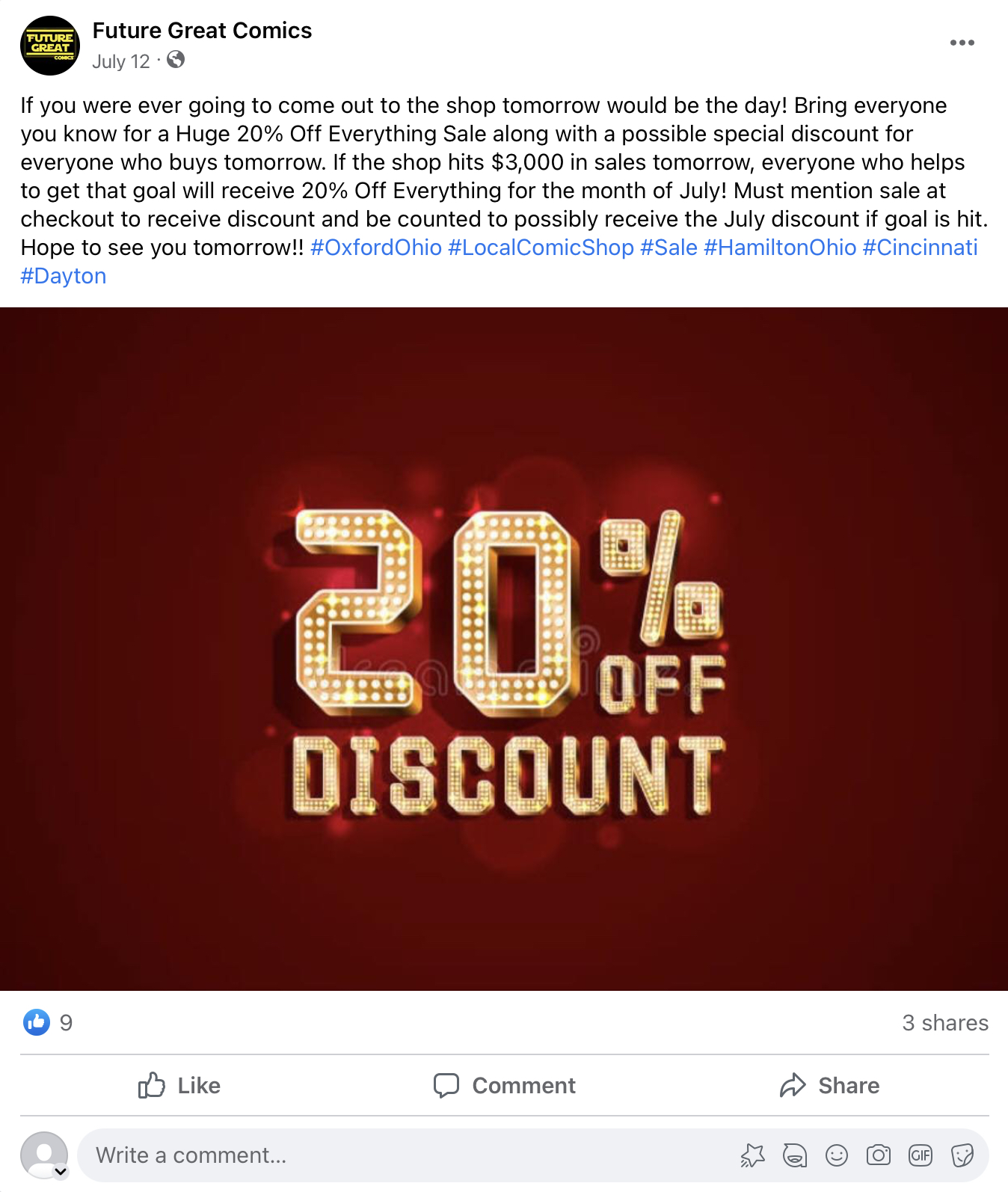
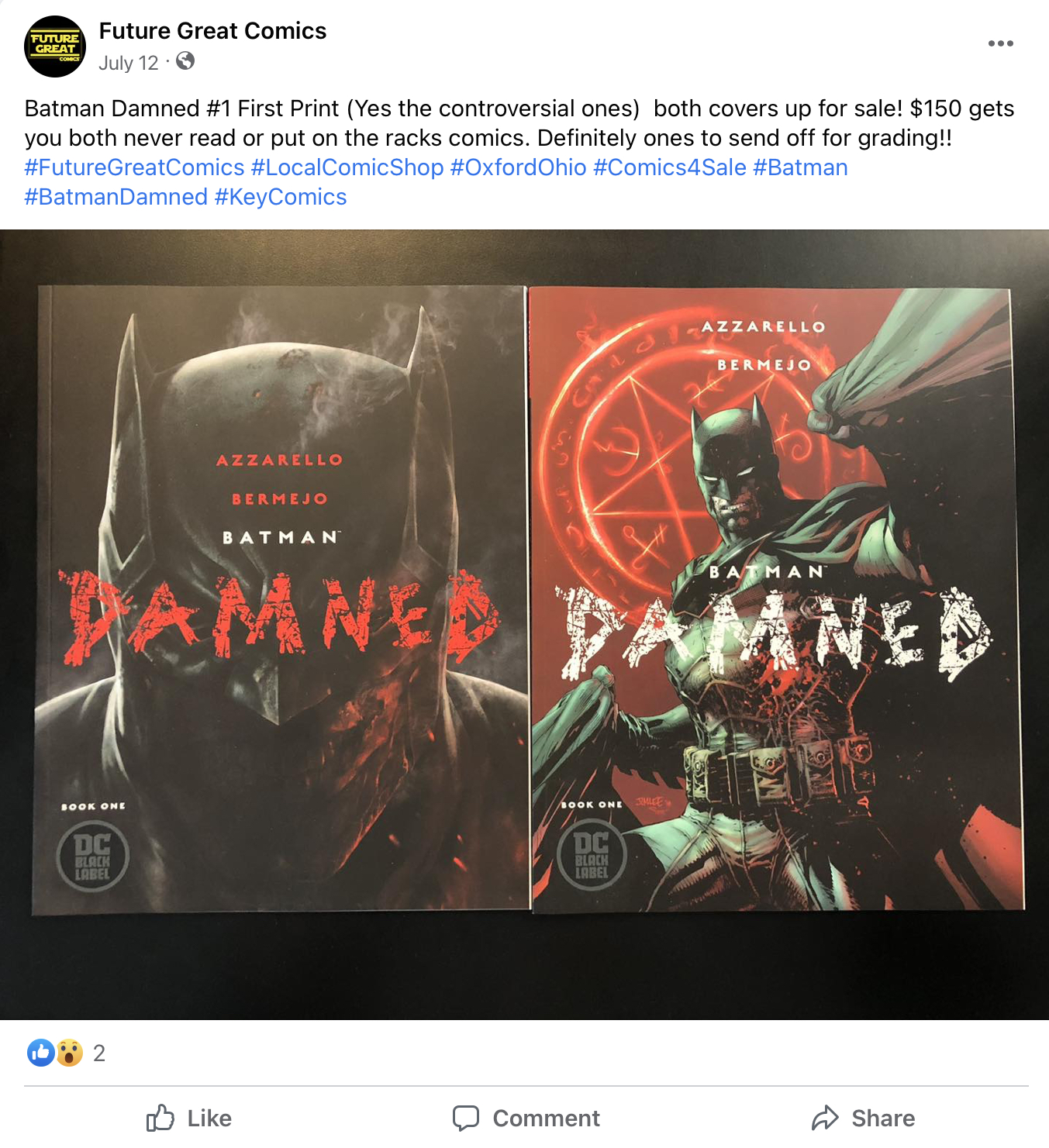
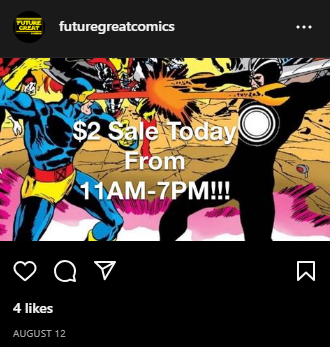
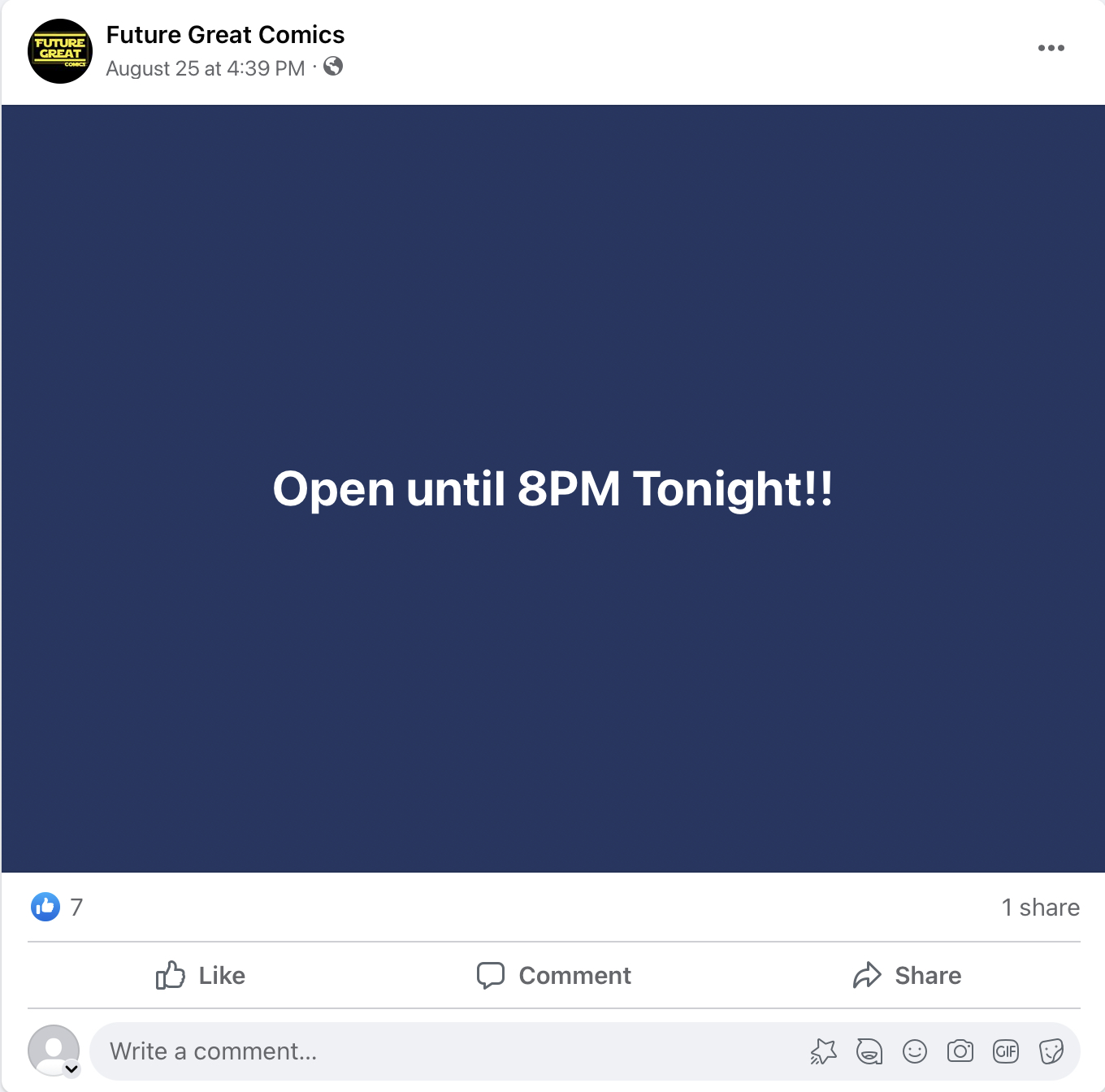
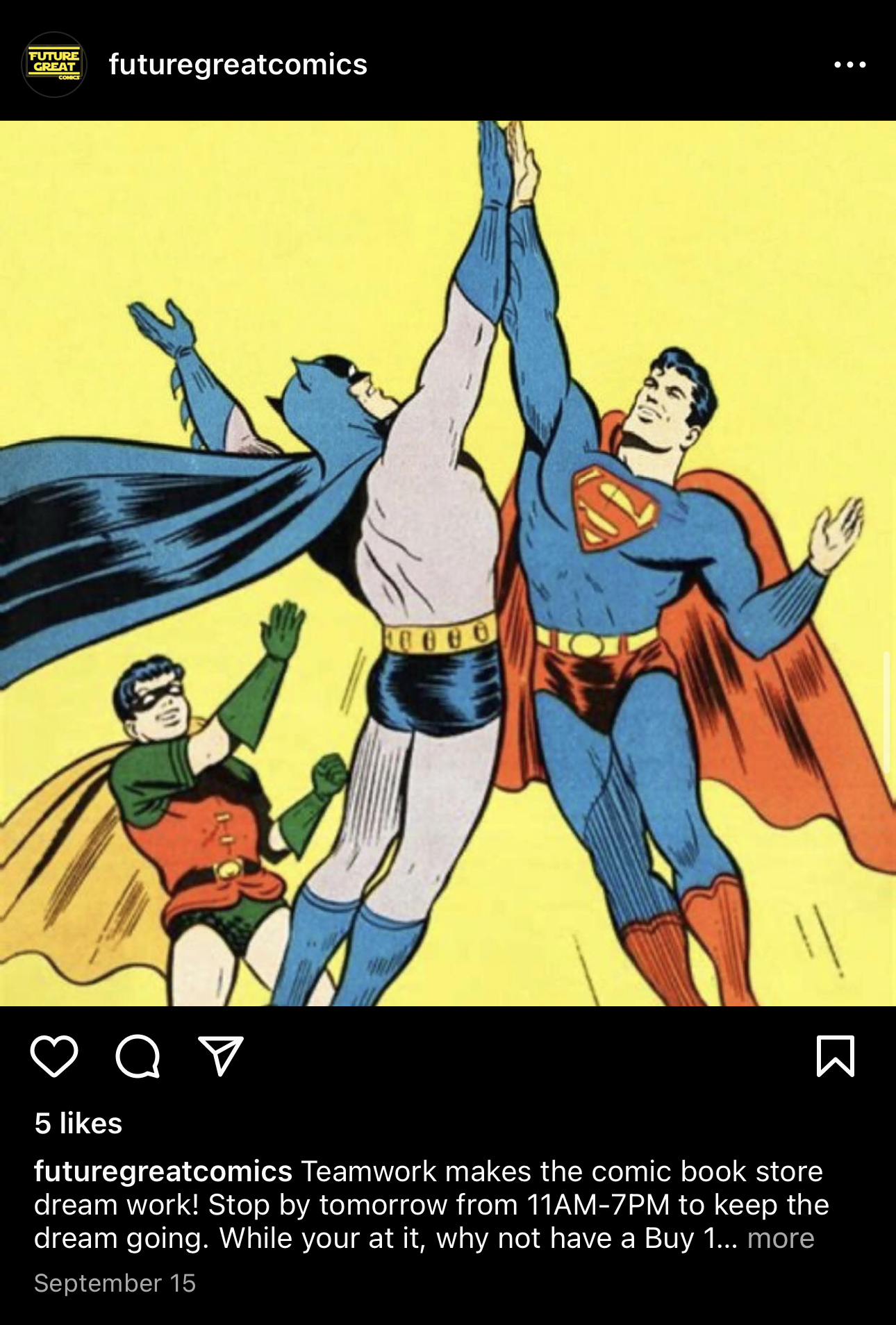
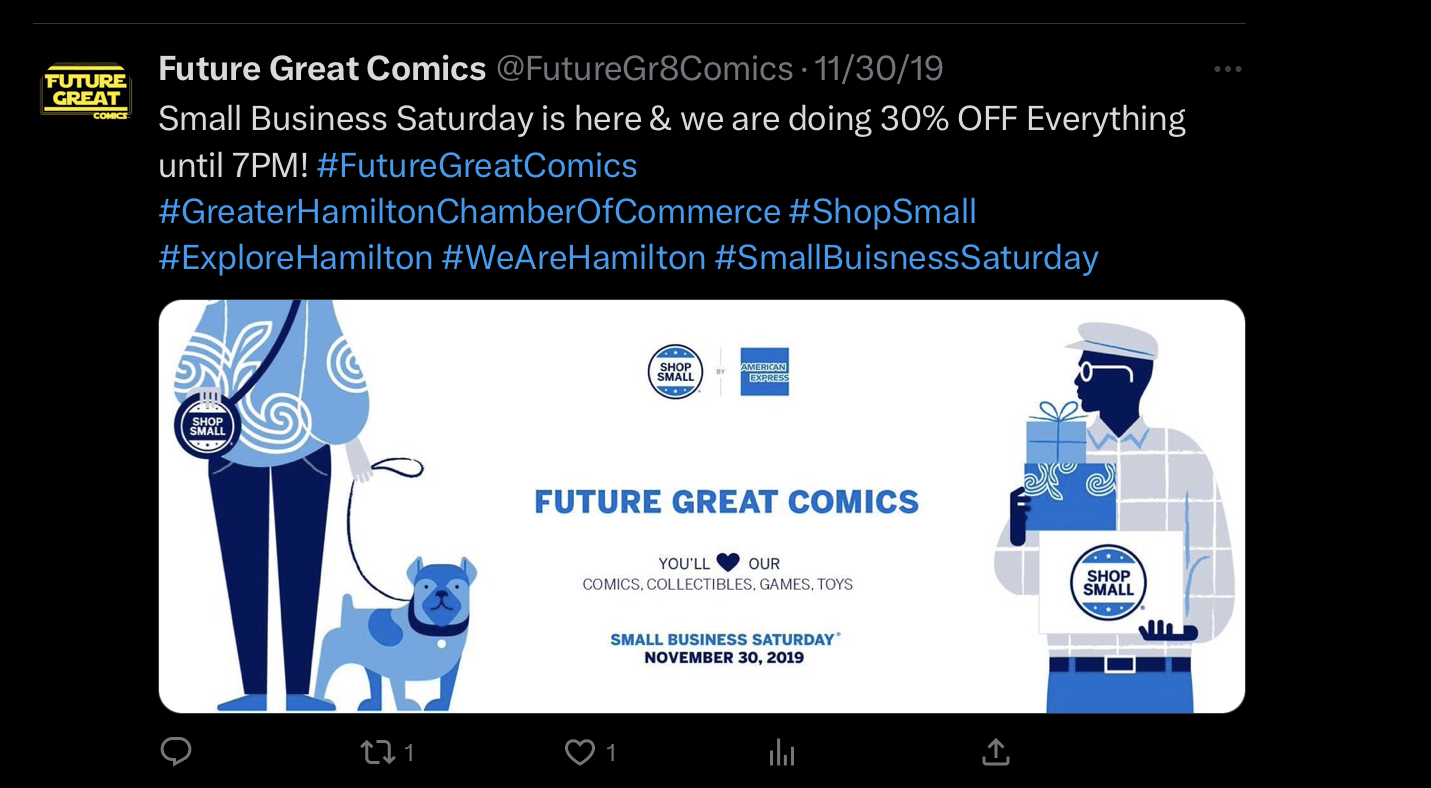
(These are two of the 16 posts made on Future Great Comics’ Facebook and Instagram accounts on July 12, 2023.)

Another factor that may have contributed to these comments being made would be the actual content of the posts themselves. Out of all of the 34 posts collected, 61.7% of them had the main topic of their posts was discussing a current sale. These posts were also presented very much like an ad rather than individual content. According to a study conducted by HubSpot, 64% of social media users view ads to be annoying/disruptive and 54% believe they disrupt what they’re doing, (An, 2020). Users simply don’t like looking at content they think is an ad, which is part of the reason ad blockers make any profits. Due to Future Great Comics’ social media content looking so much like generic ads, users can very easily start to dislike Future Great Comics’ content and choose not to engage with it in hopes of receiving less of their content.
User needs and expectations are also being failed in terms of the accessibility of Future Great Comics’ posts. According to the official Web Content Accessibility Guidelines (WCAG) set by the Web Accessibility Initiative, only about 64.7% of the 34 posts collected are understandable by disabled viewers. All of them unfortunately aren’t fully accessible to disabled viewers. This inaccessibility is due to suboptimal use of color contrast and alt text in Future Great Comics’ social media posts.
Color contrast is the measure of the difference in luminance between the foreground and background colors. It’s very important to consider when relying on users to read text on an image, since it may be the one differentiating factor between the text and the rest of the image, (W3C Web Accessibility Initiative, 2023). While people with normal vision may be able to rely on differences in hue, many users who are low vision or color blind aren’t able to distinguish certain hues from each other.
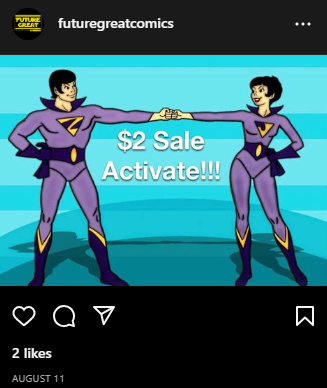
(These are all examples of posts that fail to meet contrast guidelines set by WCAG.)

Alt text or alternate text is written copy that appears in place of an image if the image fails to load on a user’s screen. This alt text is also useful for disabled users who have to rely on screen-reading tools to visually describe images to them, (Becker, 2023). By excluding alt text on social media posts with images, this unfortunately means that not everyone can benefit from the content that Future Great Comics shares. Visually impaired users are excluded from Future Great Comics’ content, which can reflect pretty negatively on their brand.
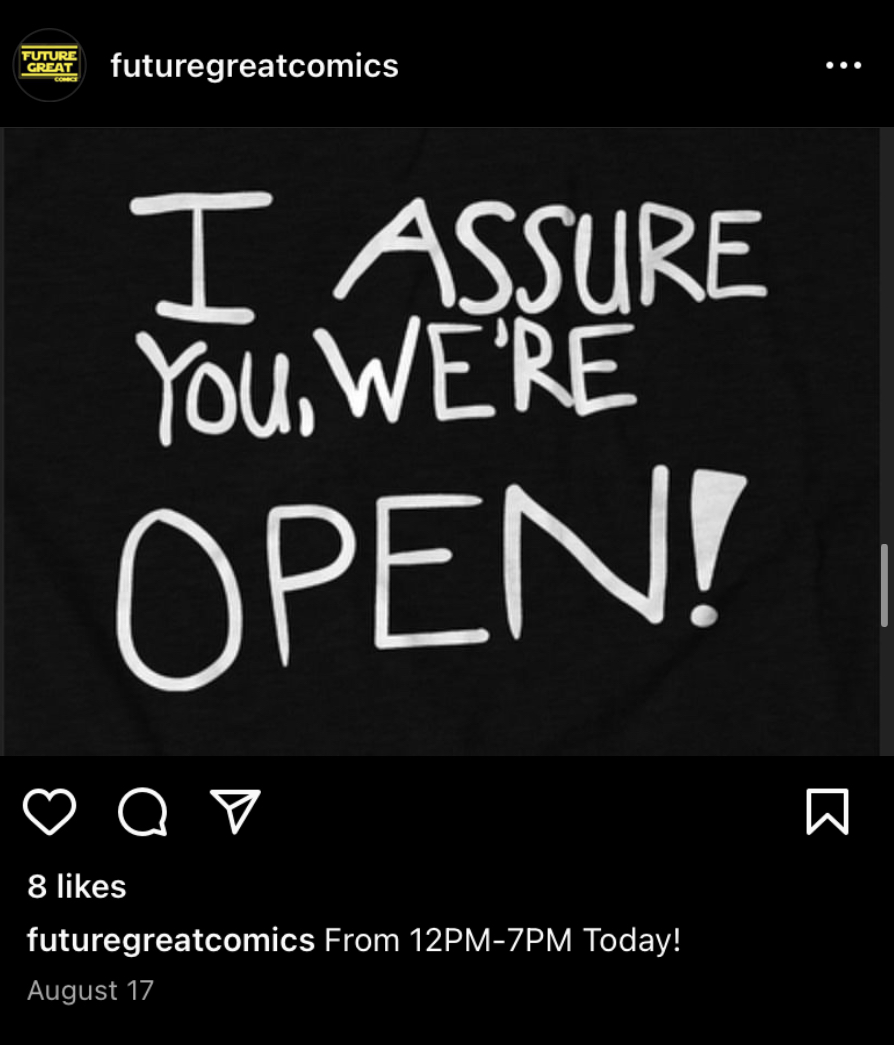
(These are all examples of posts that are inaccessible due to non-use of alt-text.)

FGC Does Not Circulate a Consistent Message that Accurately Reflects the Purpose and Value of the Community

One of the things that Future Great Comics is most known for is providing a place for all different aspects of geek culture to come together. It serves as the meeting place for all comic book lovers, TTRPG players, collectors, and many other types of people. However, this message is unfortunately not well communicated over Future Great Comics’ social media pages.
One of the best selling items in Future great Comics’ store are the dice sets. These dice are often used by board game or TTRPG players. However, even though over 85% of all 34 that were analyzed focus on sales and getting customers to buy items from the store, only 2.9% of the posts analyzed targeted board game and TTRPG players. Their largest targeted demographic in comparison, comic book readers, have 41.2% of the 34 posts dedicated to them. While Levick does a great job at catering to all of these different audiences in person, these social media accounts simply do not convey that.
During my usability and UX research, I wanted to find participants who represented many different target audiences of Future Great Comics. Participant 1 said that he is a Marvel fan who also likes reading graphic novels. He plays D&D at least once a week with his friends, and is starting to watch more anime thanks to his roommate and wants to pick up manga because of it. Participant 2 just likes to play D&D and other board games but is interested in getting more into graphic novels. Participant 3 enjoys watching anime, reading manga, and playing video games. Some of the video games she spends most time with are anime-inspired RPGs like the Persona series, Octopath Traveler, and Honkai Star Rail. She also is an avid D&D player and is currently running 2 campaigns which she plays weekly.
After inquiring about these interests, I asked if they felt like Future Great Comics was able to represent and provide for them. Although Participant 1 was hesitant, all three of them disagreed. Participants 2 and 3 both agreed that since they aren’t avid comic book fans, they felt no connection to Future Great Comics’ social media campaign whatsoever. “It’s really a shame because I love that store. Their social media just doesn’t apply to me at all,” says Participant 2. Participants 2 and 3 both said that they believe that Future Great Comics social media campaigns would be greatly improved if they started prioritizing content outside of comic books and superhero movies, while Participant 1 argued that their content just needed to include media that’s more kairotic or more recent.
Another issue I noticed with these posts is not only are certain audiences alienated through interest groups but also by location. The posts I analyzed have a strong bias towards Future Great Comics’ Oxford location over their Hamilton one. Over 58.8% of the posts analyzed referred directly to the Oxford location while the only post analyzed that mentioned the location in Hamilton was from 2020 before Future Great Comics even opened in Oxford. Although there are still 38.2% of posts that are unclear on which location it’s referring to, users from Hamilton might be doubtful that they’re referring to them based on patterns from their other posts. These patterns could lead to those users feeling forgotten about or uncared for by the business. Therefore, it should become practice for Future Great Comics to either start mentioning both locations in their posts or perhaps create a new account centered on that location if they wish to keep them separate.


FGC Does Not Make the Best Use of Affordances and Platforms to Showcase the Content

When I initially asked participants about Future Great Comics’ brand aesthetic during my usability and UX research, I received a lot of mixed and unsure reviews. Participant 1 mentioned that he really liked the business’ brand aesthetic in-store but never noticed much of one on social media. Participant 3 on the other hand seemed surprised by the question, claiming “I didn’t even know that they had one!”
In order to test the strength of Future Great Comics’ brand aesthetic, one of my tasks required participants to look at 10 posts. Of these 10 posts, 5 of them were posts from the official Future Great Comics account while the other 5 were fake posts constructed using random photos from Google Images. The average score for all three participants was 46.7% posts guessed correctly. Participant 1 guessed 7/10 correctly, Participant 2 guessed 4/10, and Participant 3 guessed 3/10. Participants 2 and 3 both struggled throughout the task. Participant 2 claimed that this task was “nearly impossible” since the posts “all looked like stock images anyway.” Participant 1 on the other hand struggled at first but eventually developed a strategy near the end that allowed him to guess 5 correctly in a row. When I asked him about his strategy, he said that “the fact that [Future Great Comics] would never post images with high quality and good artistic composition” was what helped him succeed.

(These are 4 examples pulled from the task I had my participants complete. The two images on the left are real posts from Future Great Comics’ social media while the two images on the right are pulled from Google.)

These results aligned with the results of my own research within my rhetorical analysis. I noticed when analyzing their accounts’ post layouts, there was barely any cohesion seen at all. While the posts individually might manage to give a clearer idea to any viewer on what audiences Future Great Comics serves and what their store is all about, they lack any cohesion or sense once viewed altogether. There's nothing about this feed that tells the viewer about Future Great Comics’ individuality. There’s nothing that gets them to correlate these images with Future Great Comics specifically or convince them to come inside to their physical store rather than purchase their comics or dice online.

(On the left are 6 of the 34 posts pulled from Future Great Comics’ Instagram and Facebook pages. They all look like stock photos. On the right are results that I found from searching the key terms shown on the posts, proving that they were sourced from Google.)

Not to mention, I discovered during my research that a large number of their posts were in fact just stock images pulled from Google. The first photo shown above are some of the posts I analyzed out of the 34 total from Future Great Comics’ social media accounts. I suspected that a lot of them were merely stock photos from Google images. I tested my theory and was able to find two of them just by searching the key terms. There were others that I wasn’t even able to find after searching them, yet that doesn’t change the fact that I still suspected they were stock photos.
Future Great Comics has accounts on Instagram, Facebook, and Twitter/X. It became quickly apparent after analyzing their presence on all three, that these platforms were all being misused. Starting with Instagram and Facebook, Future Great Comics’ Instragam and Facebook content are nearly identical.
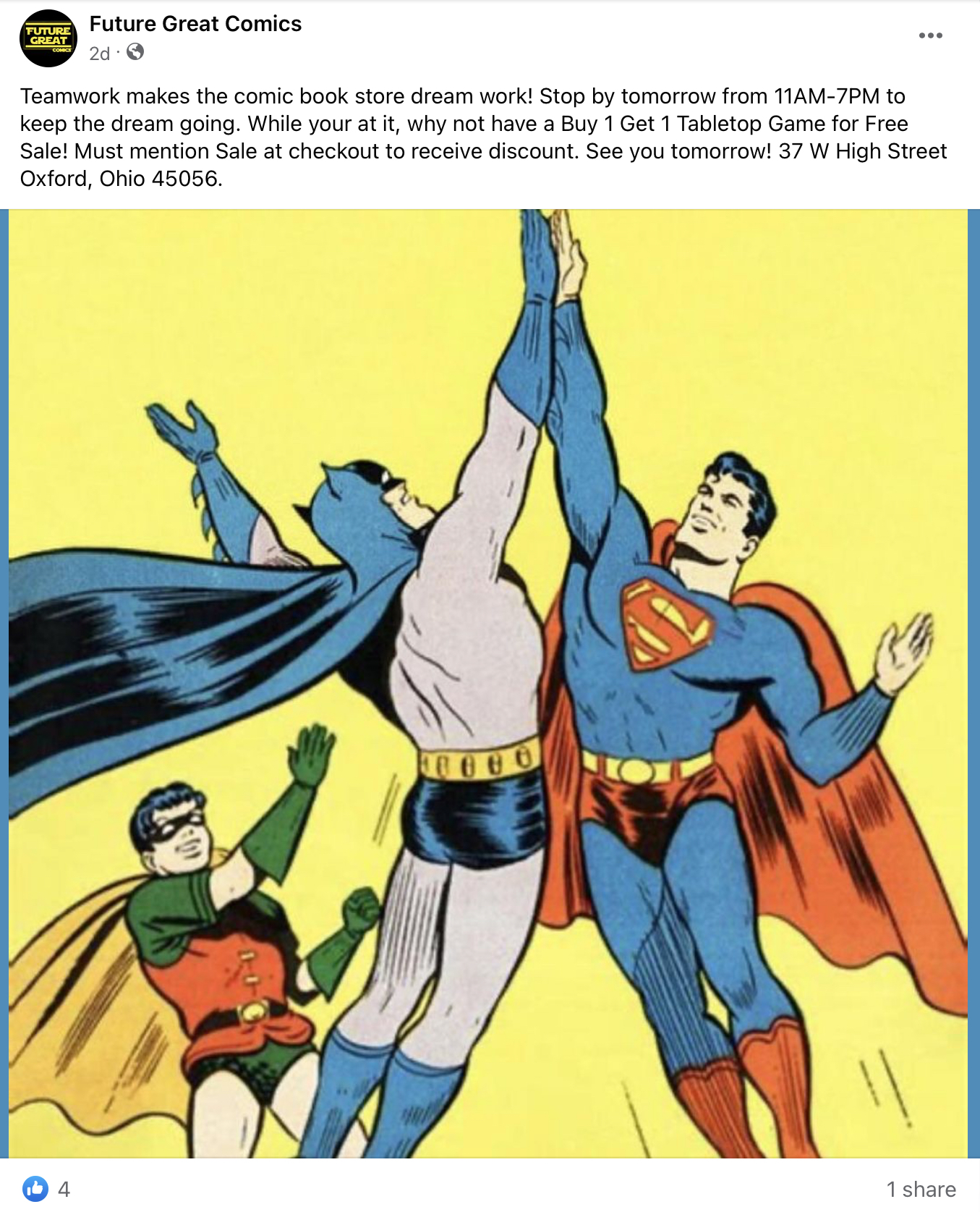
(These are two identical posts with the same photo and caption on Future Great Comics’ Facebook and Instagram pages. They were posted on the same day, within the same hour.)

Analytics have found that using the same post on multiple platforms actually lowers engagement, (Abimbola, 2023). Users could get the impression that Future Great Comics isn’t taking the time to fully engage with their audience and their content isn’t as genuine. Dedicated followers who follow Future Great Comics on multiple platforms could start to get bored of the content or even feel cheated by it, leading them to not engage as much or simply unfollow. This can also lead to certain posts being made that don’t favor each platform’s intended audience at all. Although Future Great Comics is technically trying to cater to the same audience, Instagram and Facebook have completely different sets of users.
A 2023 Instagram Engagement Report by HubSpot also notes that when it comes to captions, it’s important to either have a short and concise caption with under 20 words, or a longform caption with over 2,000. The captions of Future Great Comics’ posts average at around 27.3 words per post. There were three posts collected that had 0 captions and one post with a caption of about 94 words. A lot of the captions were also rather redundant with the information given. Eighteen of the posts analyzed included the store’s open hours, 11AM-7PM, in the caption and five of them had the store’s address. This is already information that is included in the bios of both accounts, so it doesn’t need to be repeated in the caption.
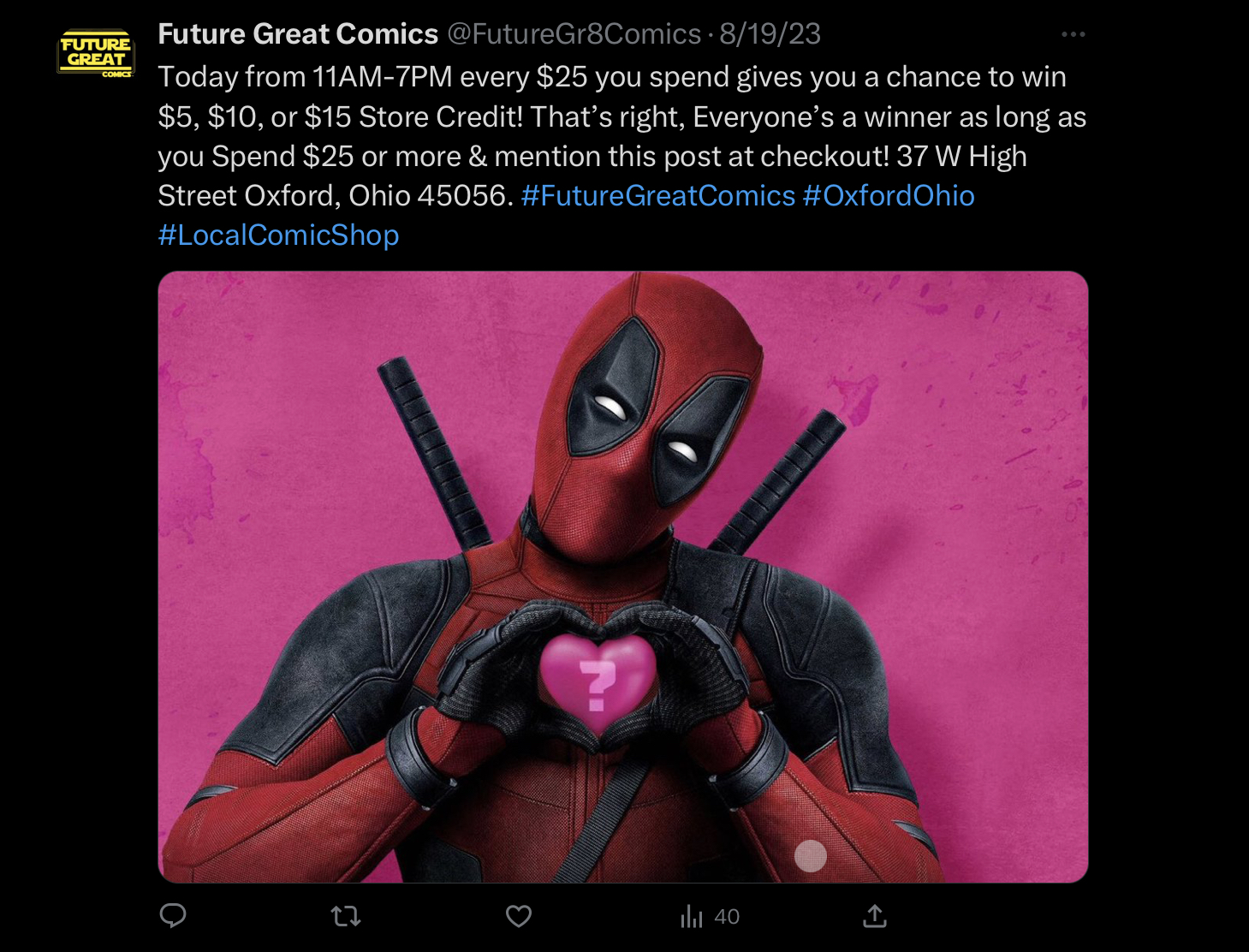
(This a screenshot of a post from Future Great Comics’ Twitter account. It features both the store’s open hours and address in the caption.)

The use of hashtags is incredibly inconsistent, if present at all. Only about 58.8% of the posts collected contained any kind of hashtags. The least amount of hashtags used on a single post was two, while the most was 21. When it comes to Instagram, the algorithm best favors posts with no more than five hashtags, (HubSpot, 2023). In terms of Facebook and Twitter, it’s recommended to only include one or two, (Sadhu, 2023). Numerous studies have shown that posts using more than 10 hashtags can kill engagement by 68.2%, (Sadhu, 2023), so it should be a priority for Future Great Comics to cut down on their hashtag usage.
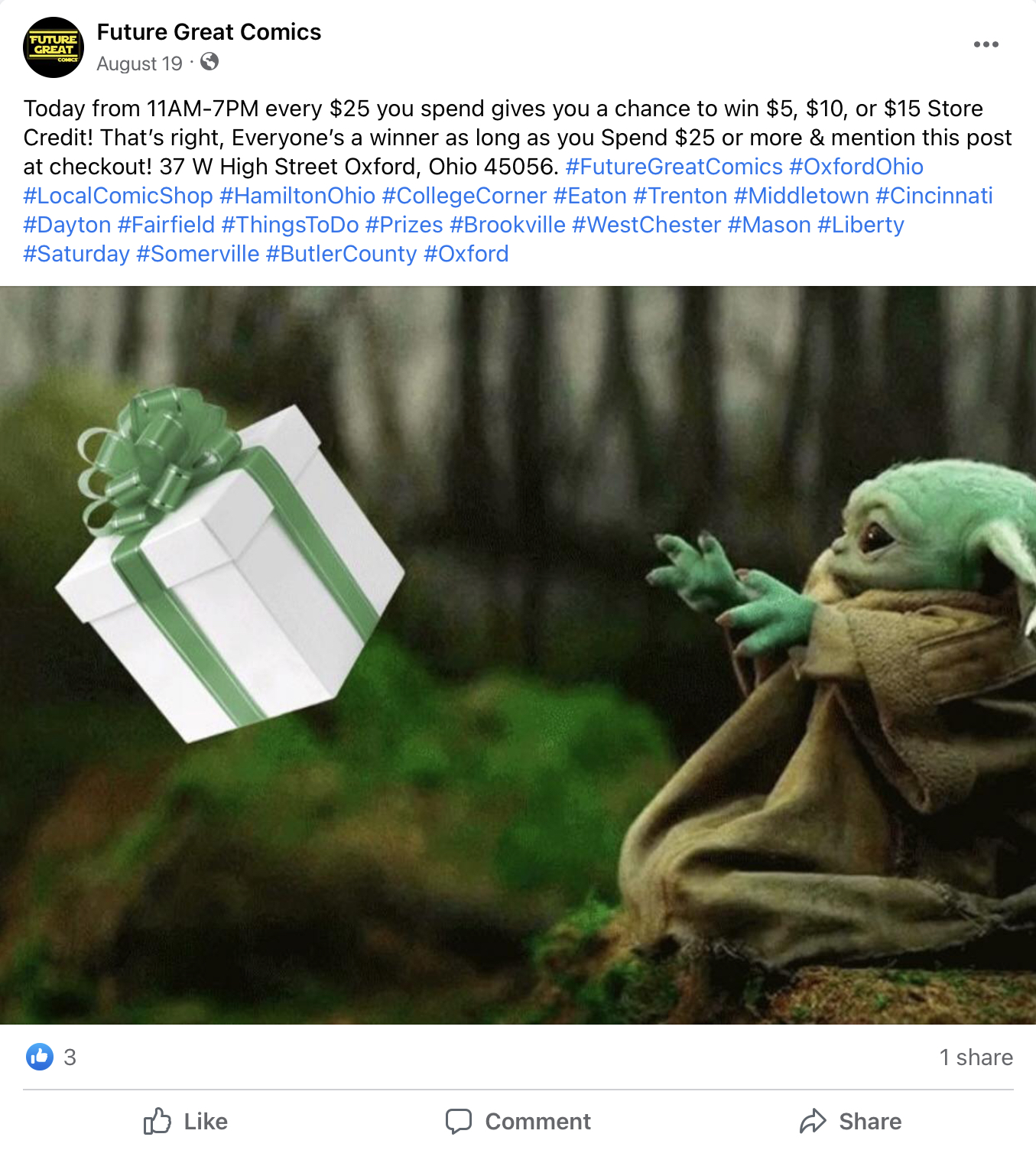
(This a screenshot of the post from Future Great Comics’ Facebook Page with the most amount of hashtags, which is 21.)

One final observation regarding Future Great Comics’ is the state of their Twitter/X account. Despite two posts that were made this August, the last post made on this account was on May 6, 2020. The account only has 89 followers, their bio and location are outdated and only mention the Hamilton location, and the two posts made on the account this August have received 0 forms of engagement at all. This account remaining in this state despite being inactive has many harmful effects for Future Great Comics’ image. It could come across to users as lazy or unmotivated. New users who stumble onto the account could get a lot of outdated and falsified information. It could also lead to a bunch of old followers of the account feeling disappointed or thinking that Future Great Comics disappeared.
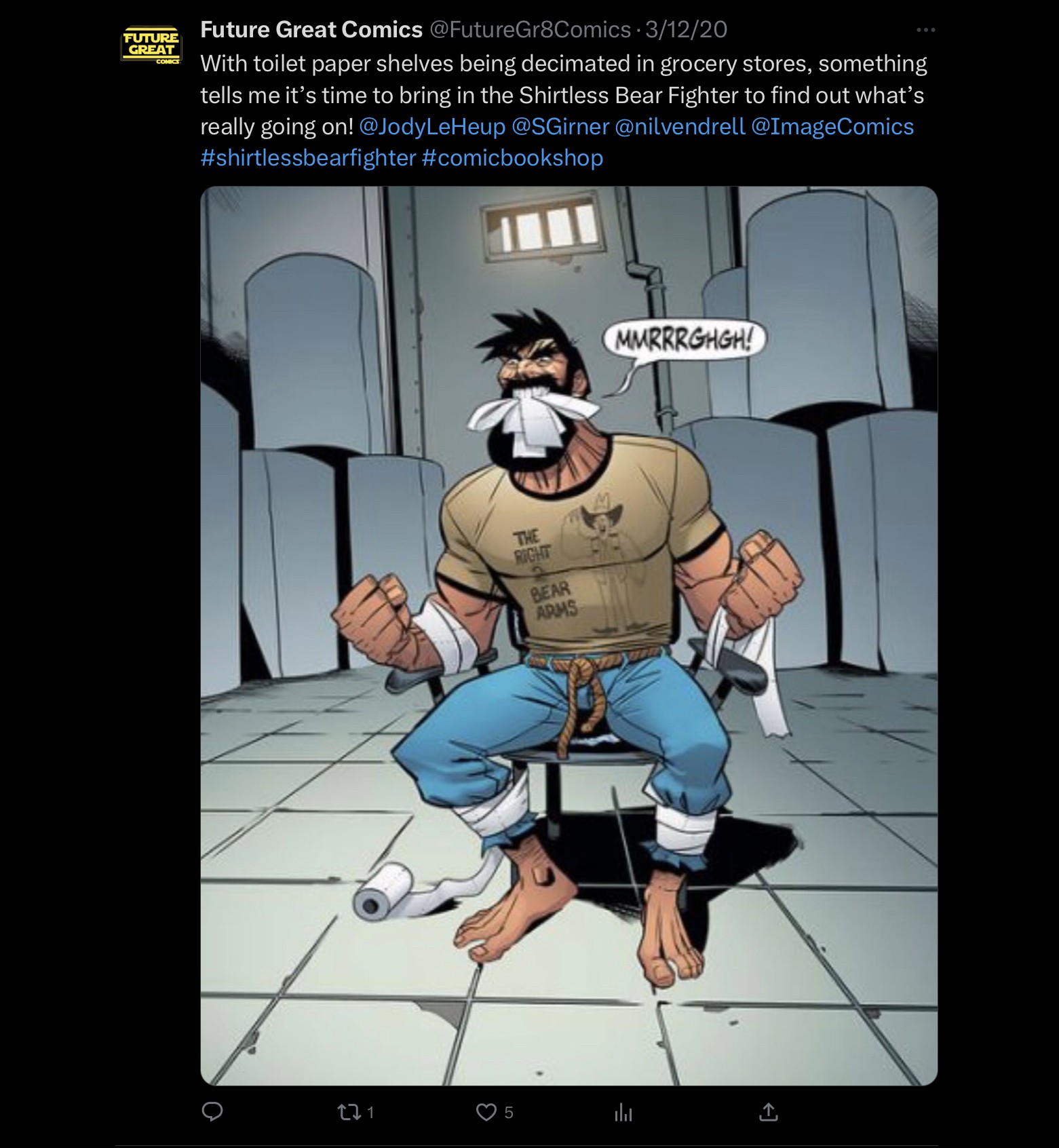
(These are two of the last posts ever made on Future Great Comics’ Twitter/X account when it was still active. These posts were made in 2020).

In order to figure out which platforms Future Great Comics should be prioritizing, I turned to my participants’ during my usability and UX research. All participants said that they use Instagram, YouTube, and TikTok. Participant 1 said that he also uses Facebook to keep up with older relatives who use it and Snapchat to message friends, while Participant 3 said that she uses Twitter/X only to message friends and Twitch to watch streamers she likes.
When asked which platform they prefer to use for following business accounts, they all agreed that Instagram was the best platform. Participant 3 explained that this was because “Instagram is the platform I use the most for general content. When I use TikTok it’s mostly because I specifically want to waste 3 hours of my life looking at funny videos. When I use Facebook it’s because I want to check in with my relatives or older friends who still use it. But when I use Instagram, it’s for a bunch of things, and that includes businesses.” She also claimed that it felt weird whenever she saw businesses promoting themselves on TikTok and Snapchat because she associates those platforms less with business. Participant 2 on the other hand explained that she’d prefer to see business content on Instagram since that platform is focused on visual content. “If a business wants to promote their products to me through social media, I obviously want to see what those products are going to look like. How else am I gonna know if I want to buy them? I think Instagram is the perfect place for businesses because of that.”
These results from both my rhetorical analysis and is clear that Future Great Comics should stick to their main platforms of Instagram and Facebook. Instagram has proven itself to be the platform where business accounts are most welcomed by users and most likely to be followed and Facebook is best for older generations who visit Future Great Comics. However, Future Great Comics needs to find a way to make sure that content on both of these platforms are somehow varied, so users who follow both accounts don’t get penalized. The results from this research also indicate that it would be in Future Great Comics’ best interest to terminate their inactive Twitter/X account. Out of the three participants I interviewed, only one of them still uses Twitter/X and they claimed only to use it for messaging other friends who still use the app. Considering the frequency of which their user base is dropping, there wouldn’t be much benefit for Future Great Comics if they were to maintain it.


RECOMMENDATIONS

This section includes my main recommendations which seek to remedy the errors discovered in my key findings in the form of a content strategy plan. My hope is that Future Great Comics is able to utilize this content strategy plan for future posts and create a brand presence that circulates a consistent message, meets users’ needs and expectations, and makes users feel engaged with Future Great Comics’ content.


Substance
Audience

Future Great Comics caters to a diverse range of audiences, reflecting the broad appeal of the products they offer. Comic book readers, manga enthusiasts, and graphic novel aficionados form a significant part of the customer base, drawn to the store's extensive collection of traditional and contemporary titles. In addition, the store caters to tabletop role-playing game (TTRPG) players and board game enthusiasts in their selling of new board games and dice sets, providing a space for them to explore new game releases and engage with fellow enthusiasts. The store also appeals to action figure and vinyl collectors, offering a variety of collectible items to add to their collections. As a local business, the store also plays a vital role in serving the communities of Oxford, Ohio, and Hamilton, Ohio. It provides a meeting place for like-minded individuals, hosts events that foster a sense of community, and contribute to the local economy by offering a unique and enriching retail experience for residents and visitors alike.
As mentioned throughout my findings, many of these audiences are often left ignored when it comes to Future Great Comics’ social media posts. Future Great Comics should expand their current social media campaign to target a broader range of demographics beyond just comic book readers and the Oxford community. By overlooking other potential audiences, the store misses out on valuable opportunities to engage with these communities. Therefore, this content strategy plan hopes to not only broaden its customer reach but also create a more inclusive and welcoming online space that reflects the diverse interests of their clientele.


Messaging / Voice and Tone

As highlighted in my core strategy statement and messaging framework, it is imperative for consumers to depart Future Great Comics’ social media page with the impression that Future Great Comics is an authoritative presence in geek culture and can fuel their passions. If users are able to believe that Future Great Comics is knowledgeable in the areas that they are passionate about, then they will be much more encouraged to interact with their posts and buy products from their store. They will be much more trusting of Future Great Comics’ brand identity and feel much more welcome in identifying with them.
When it comes to sharing this message, Future Great Comics should convey a tone that is both lively and informative. By striking a balance between being entertaining and educational, they can establish themselves as a trusted and knowledgeable source while remaining relatable to its audience. This approach allows the business to engage with its followers in a friendly and approachable manner, fostering a sense of trust and reliability. This ensures that users can find Future Great Comics’ content fun and engaging, while also recognizing Future Great Comics as an expert within geek culture.


Topics/Types of Posts

As mentioned during my findings, the main topic for a lot of Future Great Comics posts is discussing a new sale, or announcing that the store is open. While this does technically serve the core strategy statement and messaging framework I designed, this strategy isn’t that effective when it comes to engaging users. Instead, users are much more likely to think of these posts as annoying and attention-seeking. In order to truly engage audiences, Future Great Comics need to create posts with added value that interests their target demographic but also lets audiences know that Future Great Comics is a brand that is entertaining and informative.
In order to demonstrate the purpose of this added value and demonstrate its format, here is a post from Future Great Comics’ current social media campaign, and here is a post from my proposed social media campaign. Both posts share the same goal of encouraging users to engage with the post and visit the store, and they both do so under the theme of Marvel’s Loki series on Disney Plus.
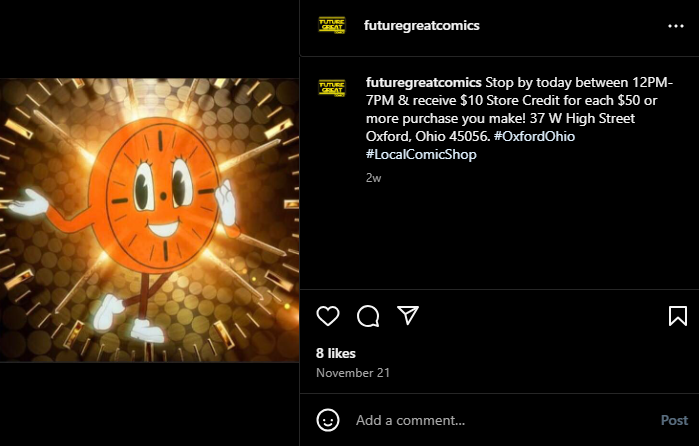

(The picture on the left is a post from Future Great Comics’ Instagram featuring the character Miss Minutes from Loki. The picture on the right is a post from my proposed social media campaign. The text on it reads: “TOP 5 INACCURACIES IN THE MCU’S LOKI SERIES Here’s a list of 5 major plot details Disney completely missed from the original Loki comics.” ).

Rather than a still image, the post from the proposed social media campaign uses an infographic format to add information relevant to comic book readers and MCU fans, which are two of Future Great Comics’ biggest demographics. By including a magic layer that focuses on extensive knowledge on different kairotic facets of geek culture such as the Loki series or Marvel comics helps to establish the business as a knowledgeable and trustworthy source within its niche. Users will be much more likely to trust Future Great Comics when it comes to recommendations on what to pick up next, or trust them to have stock in items that they want. This new format also not only captures the audience's attention but also encourages interaction and sharing, thereby extending the reach of the business's brand and message. This can lead to increased brand awareness and potential new customer acquisition. Additionally, providing value through posts helps to cultivate a loyal and engaged community around the business, which can ultimately translate into customer retention and advocacy. Overall, implementing this new post format will provide additional value to these posts which is instrumental in building a compelling and influential online presence for Future Great Comics.


Sources

When it comes to developing content for posts, the work done should be completely original. Future Great Comics should utilize the branding and style guide listed below when creating posts to help make their account feel like one of a kind. Any curated content used should be properly credited and still restructured to fit the account’s branding guidelines.


Structure
What forms will your content take?

Although Instagram doesn’t prioritize one type of content over another, a 2023 Instagram Engagement Report by HubSpot shows that the type of content that receives the most engagement is video, and the second most are carousels. According to Hubspot, “Users spend longer watching a video or swiping through a carousel than looking at one single image, and that makes it more likely to create an emotional reaction,” (Hubspot, 2023). Therefore, new content should mostly take the forms of carousels and videos rather than still images. These pieces of content will mostly resemble infographics or short educational videos. There are a few exceptions to this which include when general announcements need to be made such as the store hours changing or community events or partnerships. These exceptions should then be posted as story posts rather than main posts. If the information is imperative even after 24 hours, then the story post will be archived on the main page, but still not published as a main post.


Which platforms should be used? What content goes where?

The platforms that Future Great Comics should prioritize are Instagram and Facebook. The Twitter/X account should be deleted. The current state of Future Great Comics’ Twitter/X only serves to damper their brand. Having an inactive account with old posts that no longer serve the brand’s current image can give new users a false perception of Future Great Comics’ identity as a whole. Additionally, most of the target audience that would be on Twitter/X have most likely fled to other apps. Since users are slowly leaving the platform, there is no need to keep the account up and running.
Posts that deal with content that generally caters to younger audiences (for example, Invincible season 2, Baldur’s Gate 3, Jiujitsu Kaizen Manga, etc.) should be reserved for Instagram while posts that cater to older audiences should be reserved for Facebook. Posts that have a more general audience (for example, MCU) can be posted on either platform. Posts that deal with local events should be prioritized on Facebook but can also be posted on Instagram as a story post.


Workflow & Governance
Branding and Style Guide

Future Great Comics can easily make their posts seem more cohesive and recognizable to users by utilizing this brand style guide. When infographics are posted, they should be created with this main color scheme:
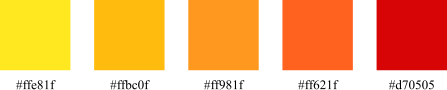
(This is the official color scheme for Future Great Comics’ social media content. The colors from left to right are: #ffe81f, #ffbc0f, #ff981f, #ff621f, and #d70505).

To ensure that these colors all look balanced when they’re used together, I also established a color hierarchy that establishes where and when they should be used:
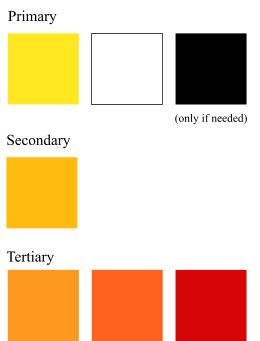

(This is the official color hierarchy for Future Great Comics’ social media content. Their primary colors are: #ffe81f, white, and black. Their secondary color is: #ffbc0f. Their tertiary colors are: #ff981f, #ff621f, and #d70505).

When following this hierarchy, the color #ffe81f should be reserved for any header text or any main elements of a post. Body text should typically be white, however if white text does not provide enough contrast, resort to black instead. If a secondary color is needed at all, use #ff981f.
If any tertiary colors are needed, use #ff981f, #ff621f, #d70505, or any combination of the three. When these other colors are used, they should not pull from the main color, #ffe81f, but rather only be used as accents.
When it comes to font choice, headers should be either in the font Horizon or Horizon Outline and all body text should be in DM Sans.
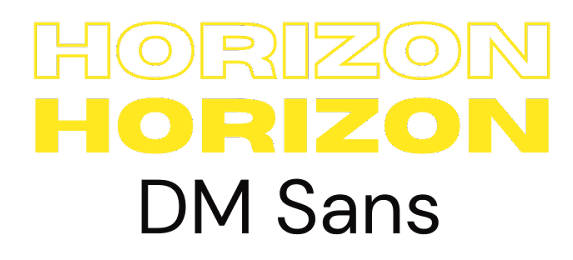
In terms of infographic imagery, they should lean into the Star Wars aesthetic present in the logo. This will help the theming of Future Great Comics’ post feel much more cohesive and professional yet also fun and engaging to viewers. This means posts could feature backgrounds that show stars, galaxies, or alien planets. Extra elements in these infographics can include spaceships, distant planets, HUDs, and etc.
This branding guide also considers post accessibility to be of great importance. One of things that will aid Future Great Comics the most when it comes to increasing engagement will be making it so everyone is able to properly engage with their content. I would suggest adding alt-text to any post made with visual content either through the caption or by using the built-in alt text feature provided on all three platforms and also putting each post through a color contrast checker before posting. Not only will this make it so low-vision and color blind users will be able to engage with Future Great Comics’ posts, but it also makes it easier for users with normal vision if they are using an older device or have different lighting within their surroundings, (Digital Accessibility Office, 2023).


Best Practices for Writing on the Web

When writing captions for each platform, they should be short and concise yet still maintain the same fun and informational tone. Captions that include questions for the audience or give them a chance to engage are best in creating attention or sparking interest and conversation. Any post that is discussing a community event, sale, or new item on the other hand should be very clear and concise so users are able to obtain all necessary information.
Two hashtags should be included with every post. HubSpot’s recommendation for hashtags is to have hashtags that fall in these main categories, Location, Branded, Niche or Industry, Communities and Fandoms, or Descriptive, (HubSpot, 2023). Considering Future Great Comics’ identity as a small local business and a comic shop that caters to a lot of niche interests, I believe the best hashtag strategy would be to include a location-centric hashtag (#Oxford, or #Hamilton), and a community/fandom-centric hashtag (#MarvelComics, #DCComics, #DungeonsAndDragons, etc.) in order to emphasize the store’s locality and dedication to the passions of their audiences.

Editorial Calendar

When it comes to remedying post frequency and the inclusion of multiple audiences, Future Great Comics should develop a content calendar. This calendar will allow Future Great Comics to make sure each of their audiences are equally catered to, avoid making posts that only focus on opening hours and sales, and avoid coming across as “spammy” to their users.
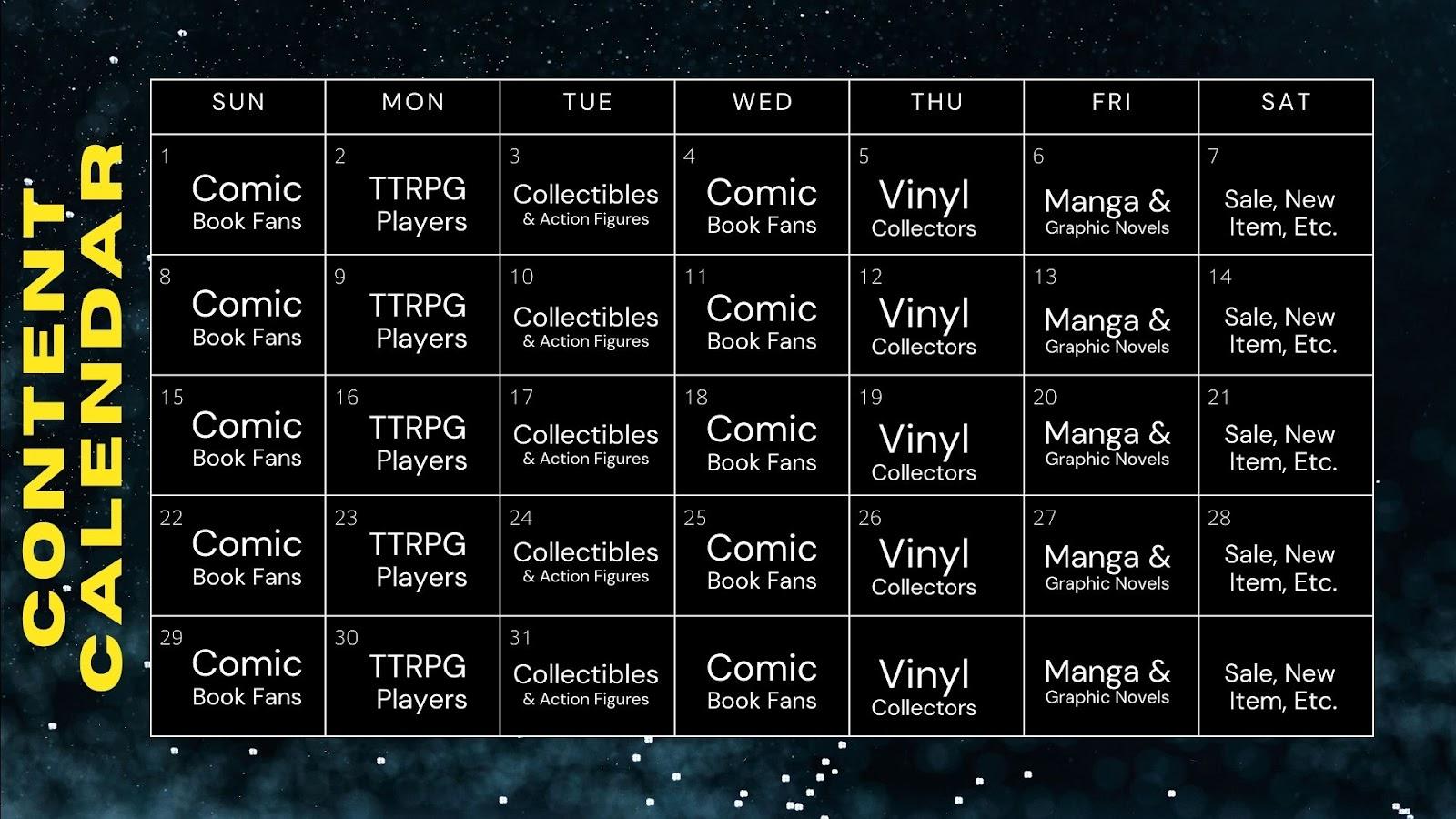
(This is the official color hierarchy for Future Great Comics’ social media content. Their primary colors are: #ffe81f, white, and black. Their secondary color is: #ffbc0f. Their tertiary colors are: #ff981f, #ff621f, and #d70505).

This calendar aims to cover both FaceBook and Instagram. Ideally, both the Instagram and Facebook accounts would be posting daily. According to Hootsuite, the best schedule would be around 1 post a day for each account. However, if that gets to be too much, settling for either 1 post a day overall and alternating on which account is posting or only about 3 posts a week on both accounts should suffice, (Christison, 2023). This would mean that posts would alternate each day between accounts during the week (ex. Sunday would be a Facebook day, Monday an Instagram day, Tuesday a Facebook day, etc.)
If there is an item or potential post idea that doesn’t address any of these audiences but still makes sense to post to the account, it should be posted on the sale/new item day. If there is another event that takes priority over that day, post it on one of the comic book days. These posts should be published around late afternoon to evening (6pm - 9pm) since that’s when people are usually most active, (HubSpot, 2023).

CONCLUSION

In summary, this content strategy plan highlights my findings from observing the current state of Future Great Comics social media campaign and interviewing previous followers of their accounts. It also provides detailed recommendations that hope to improve Future Great Comic’s social media presence that includes developing a magic layer, utilizing more technological affordances, establishing a brand style guide, and creating a weekly editorial calendar. By incorporating these recommendations, Future Great Comics may see higher engagement rates and more customers within their store.


REFERENCES

Abimbola, A. (2023, August 24). Should you post the same content to all social media platforms?. Mauco Enterprises. https://mauconline.net/should-you-post-the-same-content-to-all-social-networks/.

An, M. (2020, January 14). Why people block ads (and what it means for marketers and advertisers). HubSpot Blog. https://blog.hubspot.com/marketing/why-people-block-ads-and-what-it-means-for-marketers-and-advertisers?__hstc=77521994.19c2aea516f9597d11f0c463d0709762.1696697721547.1696697721547.1696697721547.1&__hssc=77521994.1.1696697721547&__hsfp=1541278333.

Becker, B. (2023, July 28). Image alt text: What it is, how to write it, and why it matters to Seo. HubSpot Blog. https://blog.hubspot.com/marketing/image-alt-text#:~:text=Also%20called%20alt%20tags%20and,crawl%20and%20rank%20your%20website.

Brook, C. (2018, June 7). Does posting more often on Instagram reduce reach?. Social Media Today. https://www.socialmediatoday.com/news/does-posting-more-often-on-instagram-reduce-reach-report/525082/.

Blitstein, L. (2021). Comics store opens in Oxford. Oxford Observer. https://oxfordobserver.org/5369/city/comics-brought-to-life-in-oxford/.

Christison, C. (2023, July 6). How to make a social media posting schedule. Social Media Marketing & Management Dashboard. https://blog.hootsuite.com/social-media-posting-schedule/#:~:text=On%20Instagram%2C%20post%20between%203,and%205%20times%20a%20day.

Decker, A. (2023, March 23). Everything you need to know about social media branding. Buffer Library. https://buffer.com/library/social-media-branding/#:~:text=Your%20social%20media%20branding%20gives,that%20resonates%20with%20this%20audience.

Digital Accessibility Office. (2023). Top 10 Tips for Accessibility: Color Contrast. https://digitalaccessibility.unc.edu/resources/top-10-tips/color-contrast/#:~:text=Color%20contrast%20impacts%20the%20readability,the%20lighting%20of%20their%20surroundings.

Gomez, R. (2023, September 29). The importance of Social Media Marketing: 7 stats that prove social’s role in business success. Sprout Social. https://sproutsocial.com/insights/importance-of-social-media-marketing-in-business/.

HubSpot. (2023). 2023 Instagram Engagement Report. https://www.hubspot.com/hubfs/2023_Instagram_Engagement_Report_V2%20(1).pdf?hubs_signup-url=offers.hubspot.com%252Finstagram-engagement-report&hubs_signup-cta=Download%2520Now&hubs_offer=offers.hubspot.com%252Finstagram-engagement-report&ref=buffer.com.

Martin, M. (2023, August 10). 21 social media best practices to follow in 2023. Social Media Marketing & Management Dashboard. https://blog.hootsuite.com/social-media-best-practices/.

Sadhu, S. (2023, September 28). Hashtag strategy guide for Social Media Platforms in 2023. SocialPilot. https://www.socialpilot.co/blog/hashtag-strategy#:~:text=We%20advise%20you%20to%20use,key%20activities%20throughout%20the%20network.

Spilka, D. (2016). Cross-posting on social media: Should you do it?. Semrush Blog. https://www.semrush.com/blog/cross-posting-on-social-media-should-you-do-it/.

W3C Web Accessibility Initiative, (2023). Web Content Accessibility Guidelines 2.0. https://www.w3.org/WAI/standards-guidelines/wcag/.

PLAYGROUND.exe

Explore the Playground!

BROWSE ALL MY ASSORTED PROJECTS

Explore all the other assorted designs, passion projects, and messy experiments I've created. Click on any element to view it in another window and learn more about it!


Character Motion Design

CONTACT.txt

Let's chat!

PICK A CHANNEL BELOW TO REACH ME

LINKEDIN

/in/katiebarton10

PHONE

+1 (614) 795-7924

GAMES.exe

WIP

MUSIC.exe

Plague Accomodations

Thank You Scientist

PHOTOS.exe

Katie's Photo Album

MY LIFE OUTSIDE WORK

Take a sneak peak into my life and all the things I like to do away from my desk!


VIEW.exe

View Settings

ENHANCE YOUR VIEWING EXPERIENCE

Not a fan of the color palette? Feel free to change it here:


Feeling a different background? Take your pick: